
A Comparative Review of Computer Vision Architectures for Automated Bridge Component Inspection

Abstract
INTRODUCTION
1.1 Structural Maintenance Challenges and the Constraints of Manual Inspection
The safety of transportation networks depends heavily on the structural integrity of bridge infrastructure. Currently, routine condition assessment relies on manual visual inspections by certified engineers. While this hands-on approach remains the standard regulatory practice, it introduces major operational limitations. The reliability of asset databases is affected by the subjective nature of manual visual evaluation, which can lead to inconsistent defect ratings among inspectors (Agdas et al., 2016). Additionally, these physical inspections are time-consuming and labour-intensive, and they can expose workers to safety risks when they access difficult locations, such as under-deck bearing assemblies or high-altitude pier caps.
In post-disaster settings, including urgent post-earthquake structural evaluations, these systemic limitations become important. Emergency response and recovery activities can be delayed by the sudden need for rapid safety clearances across a regional transportation network, revealing the practical consequences of inspection bottlenecks (Chen and Omenzetter, 2013).
1.2 Evolution of Structural Health Monitoring Frameworks
Early engineering research concentrated on contact-based Structural Health Monitoring (SHM) frameworks to lessen human subjectivity. These conventional approaches rely on dense networks of physical sensors, such as accelerometers, fiber-optic strain gauges, and acoustic sensors that are either directly incorporated in or linked to crucial bridge components (Hassan et al., 2023). Physical sensor arrays provide extremely precise, real-time data, but their permanent field deployment is constrained by high installation costs, ongoing power requirements, complicated data filtering, and weather-related damage.
As a result, civil engineering has increasingly moved toward remote, non-contact sensing techniques (Spencer et al., 2019). Inspection teams can now quickly record the visual condition of inaccessible bridge elements without building temporary scaffolding or stopping traffic, owing to the development of commercial Unmanned Aerial Vehicles (UAVs) and high-resolution digital cameras (Hoskere et al., 2019). The combination of drone technology and large-scale image collection has produced a surge of visual data, creating a need for automated systems that can convert raw imagery into useful engineering information without extensive manual filtering.
1.3 Foundations of Automated Computer Vision (CV) in Civil Engineering
Modern structural inspection workflows incorporate automated Computer Vision (CV) frameworks to efficiently process large drone datasets. CV is a specialized area of artificial intelligence (AI) that enables computers to analyze digital images. Rather than depending only on human screening, CV algorithms examine image characteristics, such as pixel colors, edge boundaries, and textures, to automatically detect structural anomalies.
Contemporary vision-based monitoring often uses Deep Learning (DL), particularly Deep Convolutional Neural Networks (DCNNs) (Hoskere et al., 2018). After training on annotated images of healthy and damaged steel or concrete components, these models can learn to identify complex structural defects (Spencer et al., 2019). These frameworks operate at three different levels of detail, depending on the underlying network architecture:
Object Detection: By creating distinct bounding boxes around the targets, object detection locates macroscopic distress zones or structural assets (bearings or pillars) (Zhou et al., 2026).
Semantic and Instance Segmentation: These methods carry out pixel-by-pixel categorization, defining the limits of spalling zones, corrosion patches, and cracks (Kalfarisi et al., 2020). This enables engineers to compute physical defect dimensions, such as surface area and crack width, directly (Parnia Shokri et al., 2022).
Multi-Modal Vision-Language Processing: These methods convert raw pixels into automated condition reports or written technical descriptions by pairing visual image encoders with large language model (LLM) decoders (Liang et al., 2025; Chen et al., 2026).
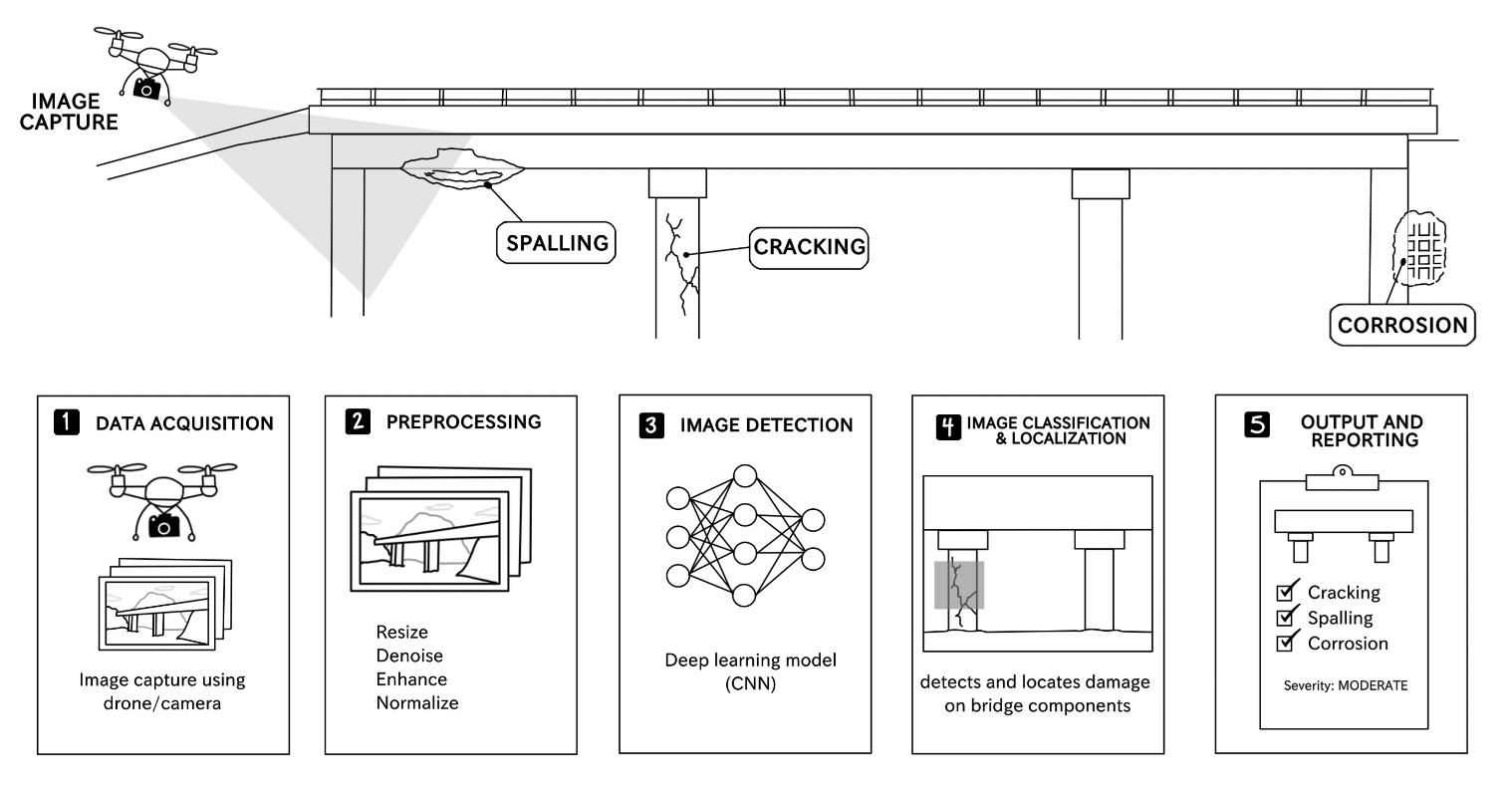
Figure 1: Automated Computer Vision (CV) Framework for Bridge Component Damage Identification.
Figure 1 illustrates a computer vision–based workflow for automated bridge inspection. Images of bridge components are collected using drones or cameras, preprocessed, and analyzed using deep learning models to detect, classify, and localize damage. Typical damage types include cracking, spalling, corrosion, and bearing deterioration in bridge decks, girders, piers, and other structural elements. The system generates inspection reports to support rapid condition assessment, maintenance planning, and asset management.
1.4 Objective and Scope of this Review
A systematic assessment of vision-based frameworks is crucial as artificial intelligence becomes increasingly integrated into civil engineering. The main goal of this paper is to present a concise, comparative analysis of computer vision architectures for automated identification of bridge components and associated damage.
2. OBJECT DETECTION AND BOUNDING-BOX ARCHITECTURES
2.1 Methodology and Application
By estimating spatial coordinates and creating bounding boxes around targets, object detection architectures locate structural assets or macro-level flaws (Hoskere et al., 2018). In bridge engineering, this is used for automated asset mapping (cataloging piers, girders, and bearings) and rapid anomaly detection (spotting severe spalling or corrosion). Inspection teams can quickly scan thousands of drone photos and identify high-priority flaws for human review because of these models' convolutional backbone feature extraction (Spencer et al., 2019).
2.2 Two-Stage vs. Single-Stage Models
The goal of developing structural object detection is to strike a balance between localized accuracy and computational speed:
Two-Stage Detectors (such as Faster R-CNN): These networks first generate candidate regions and then classify them. Their multi-step pipeline can be computationally slow, despite its accuracy in recognizing complex bridge components (Hoskere et al., 2018).
Single-Stage Detectors (e.g., YOLO, SSD): Modern frameworks often prioritize single-stage models that predict bounding boxes and defect classes in a single pass. This significantly lowers computational weight, allowing efficient, lightweight algorithms to operate directly on low-power field devices, such as drone flight controllers or inspection tablets (Zhou et al., 2026).
2.3 Structural Constraints and Limitations
Bounding-box designs have two significant drawbacks for structural analysis, despite their high processing speeds:
Coarse Boundaries: Bounding boxes provide only approximate rectangular coordinates. They cannot represent the complex, irregular shapes of actual infrastructure deterioration, such as corrosion patches or jagged concrete cracks (Spencer et al., 2019).
Absence of Quantitative Metrics: Because these models do not trace the precise perimeter of a defect, they cannot directly compute important engineering metrics such as crack width, spalled volume, or total deterioration surface area. As a result, object detection works well for quick asset mapping but is not sufficient by itself for detailed structural reliability assessment (Chen and Omenzetter, 2013). Consequently, while inadequate for accurate structural reliability indexing, single-stage object detection represents the optimal architecture for rapid screening and macro-level asset cataloging over large-scale transit networks.
3. IMAGE SEGMENTATION
Recent work uses pixel-level semantic and instance segmentation for high-precision defect quantification to get beyond bounding-box constraints (Kalfarisi et al., 2020). To trace the precise, irregular boundaries of cracks and spalling, models such as U-Net and Mask R-CNN perform pixel-wise classification. This enables engineers to compute quantitative structural indices, such as total degraded area and real crack width, directly (Parnia Shokri et al., 2022). However, these architectures continue to be extremely sensitive to changes in lighting and environmental noise, and they require large, labor-intensive training datasets (Wang et al., 2026). Despite these data overheads, pixel-wise segmentation remains the uniquely suitable approach for detailed defect measurement where sub-millimeter geometric precision is critical for structural load ratings.
4. VISION-LANGUAGE MODELS (VLMs)
Emerging Multi-modal Vision-Language Models (VLMs) provide dialogue-driven structural diagnostics through text prompts by combining image encoders with large language model decoders (Chen et al., 2025). These frameworks show adaptable zero-shot learning on unfamiliar bridge problems and produce technical reports (Jiang et al., 2025). However, the safety risk of model hallucinations and excessive processing latency still limits their field applications (Wang et al., 2026).
5. COMPARATIVE SYNTHESIS
5.1 Architectural Synthesis and Comparison
There are clear trade-offs between computational weight, data reliance, and targeted application when structural vision frameworks are compared. For real-time asset mapping of massive components like piers and girders on edge hardware, object detection architectures (like YOLO and SSD) are very field-ready due to their minimal computing footprints and little data overhead (Zhou et al., 2026).
On the other hand, semantic and instance segmentation models (such as U-Net and Mask R-CNN) require labor-intensive pixel-level training masks and have high computational weight, but they provide great geometric precision for tracing precise defect boundaries like crack width and spalling area (Kalfarisi et al., 2020; Parnia Shokri et al., 2022).
Although Multi-modal Vision-Language Models (VLMs) offer automated technical reporting and flexible multi-defect evaluation at the cutting edge, their field readiness is still constrained by significant cloud computing requirements and the possibility of diagnostic hallucinations (Chen et al., 2026; Hoier and Ahmed, 2025).
5.2 The Core Hurdle of Data Scarcity
The absence of open-source, standardized public bridge damage datasets is a significant barrier to structural health monitoring (Spencer et al., 2019). The majority of structural datasets are either proprietary or recorded in controlled laboratories, despite the fact that deep learning models need large amounts of heterogeneous data in order to generalize successfully.
Infrastructure in the real world exhibits a great deal of visual variability due to changing weather, ambient lighting, shadows, and debris. Vision models have high error rates on unfamiliar sites due to inconsistent labeling and infrequent collection of these hostile situations in public repositories (Hoier and Ahmed, 2025). Scaling robust inspection AI requires overcoming this data barrier using open-access damage libraries.
6. FUTURE OUTLOOKS AND CONCLUSIONS
6.1 Integrating Edge-AI Drone Platforms into DOT Asset Management Workflows
Department of Transportation (DOT) maintenance workflows could be significantly improved by integrating edge-computing technology on Unmanned Aerial Vehicles (UAVs) and multi-modal vision-language reporting (Liang et al., 2025). Because traditional asset management often depends on manual inspections that take weeks to record and process, it can remain reactive and slow (Agdas et al., 2016).
A future paradigm would replace this approach with a more proactive framework that unifies the CV architectures reviewed in this paper. Aerial platforms could perform real-time edge processing to identify important structural defects during flight by deploying single-stage object detection models on drone flight controllers (Zhou et al., 2026). Where severe anomalies are flag-mapped, localized pixel-wise segmentation models (Section 3) can be dynamically triggered to provide immediate, detailed defect measurement. These visual detections could then be compiled by localized multi-modal systems into standardized natural language condition reports, This bridges the gap between raw pixel analysis and automated report generation, simplifying data flow and helping asset managers prioritize repair investments (Jiang et al., 2026).
6.2 Summary
By reducing the subjectivity and safety risks associated with manual bridge inspections, automated computer vision offers an important advancement for infrastructure maintenance. This review traced the development of vision-based diagnostics across three areas: (1) pixel-level segmentation frameworks for accurate defect quantification, (2) object detection architectures for rapid asset cataloging, and (3) emerging Vision-Language Models (VLMs) for dialogue-driven diagnostics. Although data shortages and environmental noise remain practical field challenges, the combination of edge-AI drone hardware and multi-modal systems is likely to reshape infrastructure lifecycle management.
REFERENCES
- Agdas, D., J. A. Rice, J. R. Martinez, and I. R. Lasa. 2016. “Comparison of Visual Inspection and Structural-Health Monitoring As Bridge Condition Assessment Methods.” Journal of Performance of Constructed Facilities, 30 (3): 04015049. https://doi.org/10.1061/(asce)cf.1943-5509.0000802.
- Chen, X. H., and P. Omenzetter. 2013. “A Framework for Reliability Assessment of an In-Service Bridge Using Structural Health Monitoring Data.” Key Engineering Materials, 558: 39–51. https://doi.org/10.4028/www.scientific.net/kem.558.39.
- Chen, Z., E. Asadi Shamsabadi, S. Jiang, L. Shen, and D. Dias-da-Costa. 2026. “Integration of large vision language models for efficient post-disaster damage assessment and reporting.” Nature Communications, 17 (1). Springer Science and Business Media LLC. https://doi.org/10.1038/s41467-025-68216-z.
- Chen, Z., Y. Zou, V. González, J. Ingham, and L. Wotherspoon. 2025. “Bridge Inspection Using A Multi-Modal Vision Language Model.” Easychair.org.
- Hassan, S. H., Q. M. Junaiddin, N. M. Daud, M. S. A. Hamid, S. I. H. Ismail, and Z. Zakariah. 2023. “Evaluation Structural Health Monitoring (SHM) in Bridge Assessment.” Lecture Notes in Civil Engineering, 121–131. Singapore: Springer Nature Singapore. https://doi.org/10.1007/978-981-99-6022-4_7.
- Hoier, C., and K. M. Ahmed. 2025. “Structural Damage Detection Using AI Super Resolution and Visual Language Model.” arXiv.org. Accessed June 2, 2026. https://arxiv.org/abs/2508.17130.
- Hoskere, V., Y. Narazaki, T. Hoang, and S. Jr. 2018. “Vision-based Structural Inspection using Multiscale Deep Convolutional Neural Networks.” arXiv.org. Accessed May 5, 2025. https://arxiv.org/abs/1805.01055.
- Hoskere, V., J.-W. Park, H. Yoon, and B. F. Spencer. 2019. “Vision-Based Modal Survey of Civil Infrastructure Using Unmanned Aerial Vehicles.” Journal of Structural Engineering, 145 (7): 04019062. https://doi.org/10.1061/(asce)st.1943-541x.0002321.
- Jiang, Y., J. Wang, X. Shen, and K. Dai. 2025. “Large language model for post‐earthquake structural damage assessment of buildings.” Computer-Aided Civil and Infrastructure Engineering, 40 (31): 6324–6342. Wiley. https://doi.org/10.1111/mice.70010.
- Jiang, Y., J. Wang, X. Shen, K. Dai, and Q. Ge. 2026. “Multitask unified large vision-language model for post-earthquake structural damage assessment of buildings.” Automation in Construction, 182: 106720. Elsevier BV. https://doi.org/10.1016/j.autcon.2025.106720.
- Kalfarisi, R., Z. Y. Wu, and K. Soh. 2020. “Crack Detection and Segmentation Using Deep Learning with 3D Reality Mesh Model for Quantitative Assessment and Integrated Visualization.” Journal of Computing in Civil Engineering, 34 (3). https://doi.org/10.1061/(asce)cp.1943-5487.0000890.
- Liang, S., Z. He, H. Gui, and F. Liu. 2025. “DL-VLM: A Dynamic Lightweight Vision-Language Model for Bridge Health Diagnosis.” Big Data and Cognitive Computing, 10 (1): 3. MDPI AG. https://doi.org/10.3390/bdcc10010003.
- Parnia Shokri, M. Shahbazi, and J. Nielsen. 2022. “Semantic Segmentation and 3D Reconstruction of Concrete Cracks.” Remote Sensing, 14 (22): 5793–5793. Multidisciplinary Digital Publishing Institute. https://doi.org/10.3390/rs14225793.
- Spencer, B. F., V. Hoskere, and Y. Narazaki. 2019. “Advances in Computer Vision-Based Civil Infrastructure Inspection and Monitoring.” Engineering, 5 (2): 199–222. https://doi.org/10.1016/j.eng.2018.11.030.
- Wang, Y., J. Cui, C. Zhai, X. Tao, and Y. Li. 2026. “Integrating segmentation and vision-language model for automated and interpretable building damage assessment from satellite imagery.” Advanced Engineering Informatics, 71: 104320–104320. Elsevier BV. https://doi.org/10.1016/j.aei.2026.104320.
- Zhou, T., Y. Liu, Y. Hong, and Q. Pu. 2026. “Lightweight Cascade Algorithm for Concrete Crack Detection with Enhanced SSD Techniques.” Journal of Computing in Civil Engineering, 40 (2). https://doi.org/10.1061/jccee5.cpeng-7034.
Comments 0
No comments yet. Be the first to comment!
Sign in to leave a comment.