
Seismic Performance and Modeling of RC Frames Infilled with Sustainable Sandcrete and AAC Masonry Systems: Experimental Investigation

Abstract
Introduction
Bangladesh’s rapid urbanization and increasing seismic vulnerability demand structurally resilient, resource-efficient, and scientifically validated construction systems. Sustainable construction materials are increasingly adopted in reinforced concrete (RC) frame buildings to reduce environmental impact and construction costs (El-Kholy et al., 2026; Mukhlis et al., 2024). Sandcrete (SC) and autoclaved aerated concrete (AAC) blocks represent promising alternatives to conventional burnt clay masonry due to their lower embodied energy, reduced weight, and improved thermal performance (Gupta et al., 2022, Mukhlis et al., 2024). However, their structural interaction within RC frame systems under cyclic and dynamic loading remains inadequately quantified, limiting their safe and performance-based application in civil infrastructure (Mukhlis et al., 2024; Mainstone, 1971; Smith 1966). Moreover, most existing analytical models for masonry infilled RC frames are based on either simplified equivalent strut concepts or complex multi-strut macro-models (Asteris et al., 2017; Smith 1966). While such models can reproduce certain aspects of hysteretic behavior, many rely heavily on empirically calibrated parameters and are rarely grounded in experimentally measured material properties (Crisafulli 1997, Smith 1966). Furthermore, international guidelines increasingly emphasize performance-based seismic assessment of civil infrastructure (ASCE/SEI 41-17, 2017). The study aims to: i) experimentally characterize the mechanical, physical, and constitutive properties of sandcrete (SC) and AAC masonry systems and associated materials to establish reliable engineering parameters; ii) develop and validate nonlinear constitutive and rheological models incorporating material nonlinearity and foundation flexibility; iii) experimentally evaluate the structural performance of RC frames infilled with SC and AAC under pseudo-static cyclic and dynamic loading; and iv) calibrate and validate analytical models using experimental data for predictive structural assessment. This study evaluates the structural performance of RC frames infilled with SC and AAC through integrated experimental and analytical approaches. Material characterization (Phase I) and pseudo-static cyclic testing (Phase II) have been completed, while nonlinear modeling (Phase III) and model validation (Phase IV) are ongoing. This paper presents some experimental results from Phase II (pseudo-static cyclic testing), supported by material characterization (Phase I).
Materials and Methods
Material Characterization
Mechanical properties of SC and AAC masonry systems were determined through experimental testing. The tests included compression, tensile splitting, and diagonal shear tests on masonry units and prisms. Key parameters obtained include compressive strength, elastic modulus, shear bond strength, and strain characteristics. AAC masonry exhibited lower density and stiffness compared to SC masonry, while SC systems demonstrated higher strength but greater variability in material properties.
2.2 Experimental Program
The experimental study was carried out for several 1:3 scale two-story two-bay RC frame specimens as shown in Fig. 1, bare/ partially infilled with SC and AAC blocks. Pseudo-static cyclic tests were conducted using displacement-controlled loading protocols to capture hysteresis behavior. Instrumentation included load cells, displacement transducers, strain gauges, and accelerometers. The fully bare RC frame was used as a reference frame to study the effect of burnt and unburnt masonry infills on the structural behavior of the RC frame. On the other hand, the infilled test specimens were fully infilled on the left panels and remaining bare on the right panels of both stories. Table 1 shows the details of structural members of the test specimens.
Table 1: Geometric details of structural components of test specimens (All dimensions are in mm)
| Components | Sectional dimension (mm) | Longitudinal rebar (mm) | Transverse rebar(mm) |
|---|---|---|---|
| Column | 150×150 | 4-10ϕ | ϕ8@100c/c |
| Beam | 150×250 | 6-12ϕ | ϕ8@100c/c |
| Base | 450×400 | 12-12ϕ | ϕ6@75c/c |
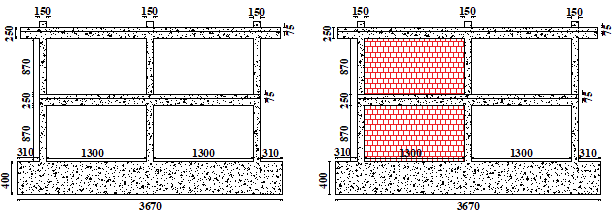 |
| Figure 1: Geometry of test specimens (a) Bare frame (b) Infilled frame |
 |
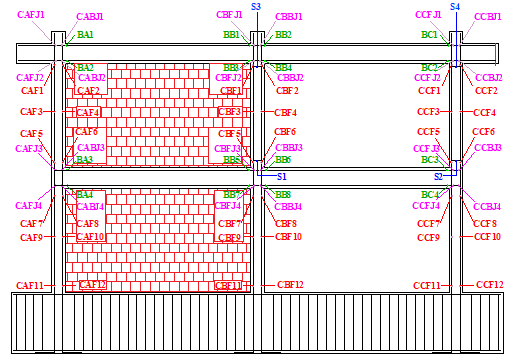 |
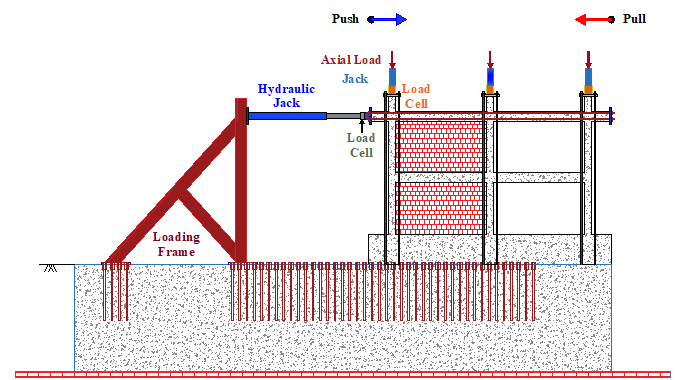
Figure 2: Experimental setup and instrumentation layout (a) Experimental setup (b) Strain gauge locations
3. RESULTS AND DISCUSSION
3.1 Structural Response
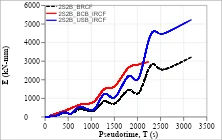
Both SC and AAC infill systems significantly increased the lateral stiffness and strength of RC frames compared to the bare frame. SC infilled frames exhibited higher initial stiffness and peak strength, while AAC infilled frames showed greater deformability. The bare frame specimen (2S2B_BRCF) demonstrated low lateral resistance (62.7 kN at 1.44% drift) with stable hysteretic behavior up to 3% drift, indicating ductile response. In contrast, the burnt brick infilled frame (2S2B_BCB_IRCF) showed significantly higher strength (116.7 kN) but failed in a brittle manner at about 1.65% drift. The unburnt block infilled frame (2S2B_USB_IRCF) exhibited intermediate strength (105 kN) with improved displacement capacity compared to the burnt brick system. Although a strength drop occurred after peak loading, the specimen maintained better deformability due to higher compressive capacity observed in material tests.
3.2 Stiffness Degradation and Energy Dissipation
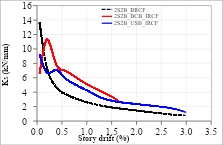
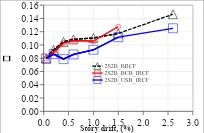
Cyclic test results showed progressive stiffness degradation in both systems. SC infills exhibited higher energy dissipation due to stronger bonding, while AAC systems showed pinching behavior and reduced hysteretic energy. Hysteretic responses (Figure 2) were used to evaluate stiffness degradation (Figure 3), energy dissipation (Figure 4) and equivalent viscous damping ratio, based on mean values from both loading directions. The burnt brick infilled specimen showed brittle post-peak degradation and failed at an ultimate drift of about 1.65%. In contrast, the SC infilled specimen demonstrated significantly higher ductility ( about 1.6 times) (Figure 2) and reached an ultimate drift of 3.0%, indicating superior displacement capacity and improved seismic performance.
 |
 |
|---|---|
| Figure 2: Lateral force- story drift curves of three specimens | Figure 3: Stiffness degradation of three specimens |
 |
 |
|---|---|
| Figure 4: Cumulative energy dissipation of three specimens | Figure 5: Equivalent viscous damping ratio of three specimens |
3.3 Failure Mechanism
Typical failure modes included diagonal cracking, corner crushing, and frame–infill separation. AAC panels exhibited earlier cracking and more brittle behavior, whereas SC panels showed more distributed cracking and improved ductility. Crack initiation and propagation reflected the relative stiffness and strength of the infill-frame system. As observed from the experiments, diagonal joint cracks were observed in all specimens, while beam-infill interface cracks appeared earlier in the SC infilled frame. The burnt brick infilled specimen exhibited earlier cracking and failure compared to the bare and SC infilled frames. Failure patterns indicate that the bare frame was governed by a flexural ductile mechanism with plastic hinges at beam ends, the burnt brick infilled frame showed brittle behavior due to the formation of diagonal compression struts, leading to premature failure and the SC infilled frame exhibited a flexural-dominated ductile response with distributed cracking and higher deformation capacity, attributed to its higher compressive strength. Key differences in cracking behavior, failure mode, and drift capacity are summarized in Table 3.
Table3: Difference in first crack drift, governing failure mode, ultimate drift and failure mechanism of all test specimens
| Parameters | 2S2B_BRCF | 2S2B_BCB_IRCF | 2S2B_USB_IRCF |
|---|---|---|---|
| First crack drift | +0.2% | -0.05% | +0.2% |
| Governing failure mode | Formation of plastic hinge at beam ends | Combined infill cracking and exterior beam–column joint damage | Combined infill cracking and formation of plastic hinge at the beam and column ends |
| Ultimate drift | +3% | +1.65% | +3% |
| Failure mechanism | Flexural-dominating weak beam pattern | Diagonal compression | Shear sliding |
4. CONCLUSIONS
Based on the experimental investigation on the three specimens, the following conclusions are drawn:
- Masonry infill significantly enhances the stiffness, strength, and seismic response of RC frames compared to bare frames.
- SC infilled frames exhibited higher strength, stiffness, and energy dissipation, while AAC infilled frames showed lower stiffness but greater deformability.
- SC systems demonstrated superior ductility and higher drift capacity (about 3%), whereas the burnt clay brick infilled systems exhibited brittle behavior with lower drift capacity (about 1.65%).
- Stiffness degradation occurred in all specimens; however, SC infills showed stable hysteretic behavior, while the burnt clay brick infilled systems exhibited pinching and rapid post-peak degradation.
- SC masonry infill provides improved seismic performance and is suitable for sustainable RC construction when properly considered in design.
ACKNOWLEDGMENTS
The authors sincerely acknowledge the Housing and Building Research Institute (HBRI), Dhaka, Bangladesh, for its financial support, laboratory facilities, and logistical assistance that enabled the successful completion of the experimental program. The authors acknowledge the use of ChatGPT (developed by OpenAI) for assistance
in language refinement, editing, and formatting of the manuscript.
REFERENCES
Asteris, P. G., Cavaleri, L., Di Trapani, F. and Tsaris, A. K. 2017. Numerical modeling of out-of-plane response of infilled frames: State-of-the-art and future challenges for the equivalent strut macromodels. Engineering Structures, 132:110-122.https://doi.org/10.1016/j.engstruct.2016.10.012
ASCE/SEI 41-17. 2017. Seismic Evaluation and Retrofit of Existing Buildings. American Society of Civil Engineers, Reston, VA, USA.
Crisafulli, F. J. 1997. Seismic behaviour of reinforced concrete structures with masonry infills. PhD Dissertation, University of Canterbury, Christchurch, New Zealand.
El-Kholy, A.M., Sayed, H., Metwally, I.M. 2026 Macromodeling and experimental investigation of RC frames infilled with clay bricks and autoclaved aerated concrete blocks under cyclic loading. Bulletin of Earthquake Engineering 24, 3173–3209. https://doi.org/10.1007/s10518-025-02358-9
Gupta, P., Jagneed, D. and Uniyal, H. 2022.AAC blocks an innovation as echo-friendly materials in construction. Novel Innovations and Sustainable Development in Civil Engineering(NISDCE’22)
Mainstone, R. J. 1971. On the stiffness and strengths of infilled frames. Proceedings of the Institution of Civil Engineers (1971) 49 (2):230. https://doi.org/10.1680/iicep.1971.6267.
Mukhlis, M. R., Das, A., Islam, S. M., Bhuiyan, M. A. R.and Sikder, A. M. 2024.Experimental Study on Cyclic Behavior of RC Frame Infilled with Sandcrete Blocks. 7th International Conference on Advances in Civil Engineering (ICACE-2024),12-14 December 2024, CUET, Chattogram, Bangladesh
Smith, B. S. 1966. Behavior of square infilled frames. Journal of the Structural Division, ASCE, 92(1): 381–403.
Comments 0
No comments yet. Be the first to comment!
Sign in to leave a comment.