
Technology Convergence of Hydrokinetic Energy Conversion Systems

Abstract
1. INTRODUCTION
Since the dawn of time, mankind has relentlessly endeavored to harness the power from moving waters whether its for transportation, agriculture or for electric power generation. What used to be humble waterwheels evolved into run-of-the-river micro-hydro plants at the turn of the century. In modern electric power systems, large-scale hydroelectric generation produces thousands of megawatt of renewable power. This progression continues even today.
The class of hydrokinetic energy conversion pertains to utilization of kinetic energy in river streams, man-made waterways, tidal flows and ocean currents in generating electricity. This emerging field of renewable energy exploration has seen a strong resurgence over the last two decades driven by the advancements in multiple fields, namely, electro-mechanical devices, power electronic conversion and offshore technologies. This has led to the development of a plethora of concepts, many of which advanced to trials, pilot projects, near-commercial deployments achieving varying degrees of success.
In a conventional hydroelectric plant, the stored static energy of water (often referred to as the 'head') in a reservoir behind the dam is used to run the turbomachinary downstream. In contrast, hydrokinetic energy conversion systems (HECS) are generally constructed without significantly altering the natural course of the water. To scale up the production, often an array of devices is contemplated similar to wind farms. While modularity and scalability are attractive features, it is also understood that hydrokinetic systems would be more environmentally friendly when compared with conventional hydroelectric plants. This is simply because the footprint is small and modular deployment can be pursued to scale up the plant size. Figure 1provides a conceptual outline of a hydrokinetic system.
As highlighted in the author's previous work [1][2], early prototypes of hydrokinetic systems were meant for generating electricity for remote and rural communities (see Figure 2}. Many of these were developed in the 60s and 70s [3][4][5][6][7][8]. During the last two decades, a significant number of new devices, companies and consortia have come into the picture- advancing the technology to near-comercial stage [9][10][11][12].

Figure 1: Outline of a hydrokinetic energy conversion system (HECS)
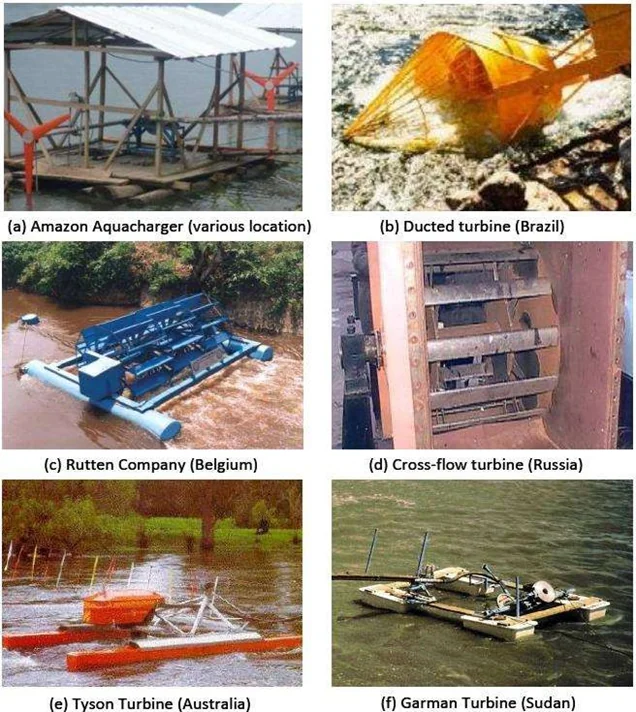
Figure 2: Early prototypes of HECS
While the interest in this field is obvious, hydrokinetic energy generation is yet to reach a commercial level. Despite the abundance of concepts and pilot-projects, only a few devices have managed to reach real-world trials. Some
of the devices - along with their developers- have ceased to exist today. On the other hand, several new technologies, albeit fundamentally similar in concept, have taken the center stage and continue to show promise.
2. CONVERSION SCHEMES
The energy flux contained in a fluid stream is directly related to its velocity and density. The effective cross-sectional area of the device is also a key factor. While there is a theoretical ceiling of how much power can be harnessed by a device, the conversion efficiency of the hydrodynamic, mechanical and electrical subsystems collectively reduces the overall output. While rotary systems such as horizontal and vertical axis turbines are generally considered as prime choices for such schemes, other non-turbine approaches are also possible. A brief description of twelve (12) concepts categorized in two broader classes (turbine/non-turbine) is given below:
Turbine systems
• Horizontal (Axial): Often called 'axial turbines', these devices are characterized by their rotor axis which is inline with the incoming water (e.g. [13]) and have an appearance of an inverted wind turbine.
• Vertical: Devices that have a cylindrical shape with its axis of rotation vertical to the incoming water (e.g. [14]). These are often called 'egg-beater' type turbines.
• Cross-flow: Devices that have a cylindrical shape with their axis of rotation horizontal to the water surface (e.g. [15]). These devices have a general appearance of a water wheel.
• Venturi: Devices where a venturi tube creates a pressure gradient forcing the incoming water to gain speed and run a turbine (e.g. [16]).
• Gravitational Vortex: Devices where the flow of water is diverted into a channel that artificially induces a vortex which in turn operates a turbine (e.g. [17]).
• Archimedes Screw: Devices that have a helical surface around a vertical shaft and divert the incoming water in an upwards spiral impinging on a turbine (e.g. [18]).

Figure 3: Turbine systems
Non-turbine systems
• Underwater Kites: Devices that are tethered to the seabed and move underwater similar to a "kite," producing power through a turbine mounted on the moving structure [19].
• Vortex induced vibration: Devices that employ vibrations resulting from vortices forming and shedding on the downstream side of a bluff body placed in a current [20].
• Oscillating hydrofoil: Devices that harness the vertical oscillation of hydrofoils and pump pressurized fluids to rune turbines [21]. A variant of this class includes biomimetic devices for energy harvesting [22].
• Flutter Vane: Devices that are based on the principle of hydroelastic resonance in free-flowing water [23].
• Tidal sail: Devices that employ drag motion of circularly moving sheets of foils placed in a water stream [24].
• Piezoelectric: Devices that utilize piezo property of polymers that produce electricity due to pressure induced by an incoming water stream [25].
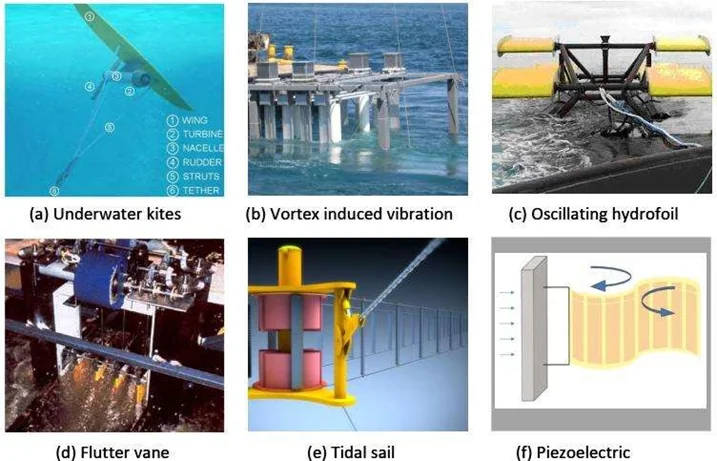
Figure 4: Non-turbine systems
At present, various turbine concepts and designs are being widely pursued (Figure 3), while the non-turbine systems (Figure 3) are mostly at the proof-of-concept stage (with some exceptions).
Two main areas where hydrokinetic devices can be deployed: (a) tidal-current and (b) river-stream. Energy from subsea ocean currents is another niche area where the flow is unidirectional, as opposed to bidirectional tidal flows. In addition to these, other areas of application include man-made channels, irrigation canals and industrial outflows. While all hydrokinetic devices operate on the same conversion principles regardless of their areas of application, a set of subtle differences may appear in the forms of design and operational features.
3. TECHNOLOGY SURVEY
The following section provides a survey of hydrokinetic energy conversion technologies, and sheds light on their diversity, progression, trends and convergence. Being an evolving and dynamic field, it is nearly impossible to provide an exhaustive and comprehensive survey. With a general focus on applied technologies that have demonstrated inclination toward commercialization, this survey explored nearly 100+ systems. Due to availability of limited information for many devices, mostly the primary conversion hardware and their peripherals (rotors, ducts, placement method in a stream, etc.) are evaluated. The information gathered along the process is organized through the following categories:
- Application: In the previous section, various areas of application for hydrokinetic devices have been identified. This discussion is carried forward into the survey by categorizing the potential use of a given device into (a) tidal-current (for tidal and ocean current resources) (b) river-stream (for free-flowing/zero-head rivers), and (c) multi-application (river, tidal, and other applications). While the information disseminated through the relevant technology developer, research institute, or public-domain document has been the basis of this classification, several ambiguous cases have been considered as ‘Multi-application’.
- Technology type: Considering the discussion presented earlier, all of the 76 devices or concepts have been attributed to one of the ten (10) conversion schemes. However, further division into ‘turbine’ or ‘non-turbine’ systems has not been carried out.
- Duct: Ducts are engineered structures that elevate the energy density of a water stream as observed by a hydrokinetic converter. Considerations for these devices is of high significance primarily because of two opposing reasons (a) potential to augment the power capacity and hence reduce the cost of energy (b) lack of confidence as far as their survivability and design/demonstration are concerned. In this survey, attempts were made to identify whether a given scheme is considered for duct augmentation (unknown cases were identified separately) or not.
- Placement: The method of placement of a hydrokinetic device, in relation to a channel cross-section, is a very significant component for two basic reasons:
The energy flux in the surface of a stream is higher than that of a channel bottom. In addition, this quantity takes diverse values depending on the distance from the shore and channel geography. Therefore, water velocity has a highly localized and site-specific 3-dimensional profile and rotor positioning against such variations will dictate the amount of energy that can be effectively extracted.
Competing users of the water stream (recreational boats, fishing vessels, bridges & culverts, etc.) would essentially reduce the effective usable area for a turbine installation.
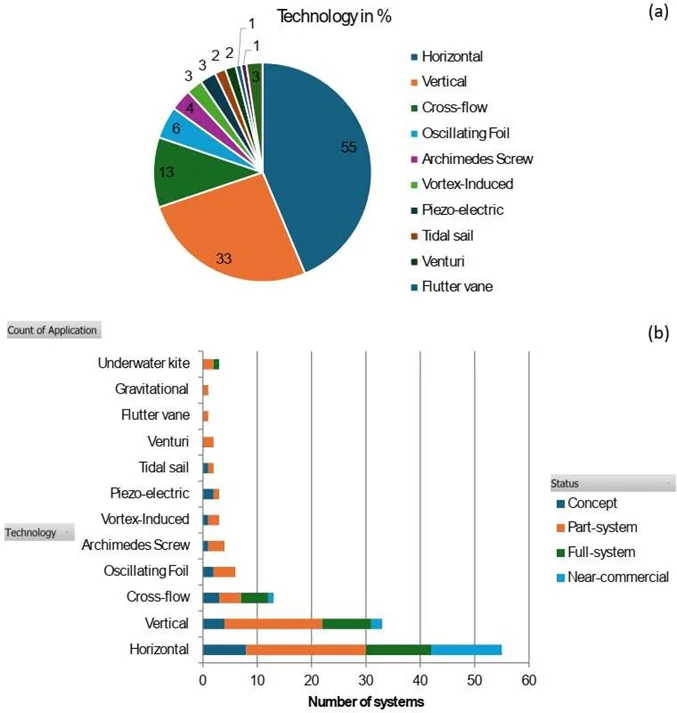
Figure 5: Technology survey (a) percentage of total (b) technology progression
While both vertical and axial turbines have long been considered as primary choices for hydrokinetic energy conversion, a number of unconventional concepts (such as vortex-induced vibration, and piezoelectric conversion) have appeared recently. Several early river turbine prototypes were deployed and operated from late
70’s to late 90’s until these were eventually decommissioned. Various non-turbine concepts (namely, oscillating hydrofoil and piezoelectric conversion) had gained good attention in the past. However, their present status of development is unknown. Analyzing the modern-day history of hydrokinetic energy conversion, it can be clearly noticed that the present decade has so far seen the greatest level of research and development initiatives. These efforts have enveloped a multitude of technological concepts as well as diverse fields of applications where hydrokinetic technologies may prosper in future (see Figure 5).
4. SUMMARY
In this paper, the state of the hydrokinetic energy conversion technologies has been revisited with an emphasis on indicating the current trends in research and development initiatives. The major conclusions that can be derived from the discussions presented earlier are:
- Except for some early commercial systems (small-scale remote power generation from river streams), most of the technologies are at the proof-of-concept or part-system R&D stage.
- A number of novel schemes (such as piezoelectric, biomimetic, and vortexinduced-vibration) have surfaced in recent times, in addition to the continued progress on classical hydrokinetic energy conversion approaches (vertical, axial turbines, etc.).
- In the presence of a wide variety of terminologies attributed to the fundamental process of kinetic energy conversion from water streams, the term ‘Hydrokinetic’ energy conversion can be used as long as sufficient caveats are given for diverse fields of application such as, rivers, artificial channels, tides, and marine currents.
- In addition to the specific focus on river or tidal current conversion, strong emphasis is given to technologies that may serve both of these areas as well as other potential resources (such as, man-made canals, irrigation channels, and industrial outflows).
- While both axial and vertical axis turbines are being developed for hydrokinetic energy conversion, considerations for duct usage have seen higher preference for the latter class.
- Various options for turbine placement with respect to a channel cross-section (bottom, floating, or nearsurface/fixed) are being given almost equal emphasis. However, axial turbines are mostly being considered for placement at the bottom of a channel, whereas vertical turbines are being designed for either floating or near-surface mounting arrangements.
- Recent technological advancements and project-development initiatives clearly indicate a rejuvenated interest in the domain of hydrokinetic energy conversion.
As the hydrokinetic technologies evolve over time, new solutions emerge, and old concepts resurface/disappear, the review presented in here may need to be re-evaluated. However, the major observations made in this section may still appear useful in identifying the technology trend being followed in this field of energy engineering. To conclude this discussion, it can be stated that hydrokinetic energy technologies are emerging as a viable solution for renewable power generation, and significant research, development, and deployment initiatives need to be embarked upon before realizing true commercial success in this sector.
5. REFERENCES
[1] M.J. Khan, M.T. Iqbal, J.E. Quaicoe. River current energy conversion systems: Progress, prospects and challenges. Renewable and Sustainable Energy Reviews, 12(8):2013–2264,2008.
[2] M.J. Khan, G. Bhuyan, M.T. Iqbal, J.E. Quaicoe. Hydrokinetic energy conversion systems and assessment of horizontal and vertical axis turbines for river and tidal applications: A technology status review. Applied Energy, 86(10):1823–1835, 2009.
[3] Richard Montague, Accessed Oct. 2025. URL https://forum. all-energy.co.uk/wpcontent/uploads/2022/06/Richard-Montague Completing-the-Circle-of-Hydrokinetic-River-TurbineDevelopment.pdf.
[4] Geraldo L. and Tiago Fo. The state of the art of Hydrokinetic power in Brazil. International Small Hydro Technologies, Buffalo, NY, USA, July 2003. Pre-conference Workshop.
[5] Rutten L. Au fil de l’eau, une roue à aubes. Systèmes Solaires, 100: 103–105, 1994.
[6] N. Usachev, Yu. B. Shpolyanskii, and B. P. Istorik. Performance Control of a Marine Power Plant in The Russian Arctic Coast and Prospects for The Wide-Scale Use of Tidal Energy. Power Technology and Engineering, 38(4):188–193, July 2004.
[7] Tyson Turbine, Accessed Oct. 2025. URL https://www.builditsolar.com/ Projects/Hydro/FlowOfRiver/FlowOfRiver.htm.
[8] David Ainsworth, Jeremy Thake, [Marine Current Turbines Ltd, for DTI (UK)]. Final Report on Preliminary Works Associated with 1MW Tidal Turbine Project. Technical Report T/06/00233/00/00; URN 06/2046, U.S. Department of Energy, Aug. 2006.
[9] Niebuhr, C.M., van Dijk, M., Neary, V.S., Bhagwan, J.N. A review of hydrokinetic turbines and enhancement techniques for canal installations: Technology, applicability and potential. Renewable and Sustainable Energy Reviews, 113, 2019.
[10] H. Tiismus, V. Maask, V. Astapov, T. Kor˜otko and A. Rosin. Stateof-the-Art Review of Emerging Trends in Renewable Energy Generation Technologies. IEEE Access, 13, 2025.
[11] Pankaj Kumar Yadav, Ankit Kumar, Satyanand Jaiswal. A critical review of technologies for harnessing the power from flowing water using a hydrokinetic turbine to fulfill the energy need. Energy Reports, 9, 2023.
[12] W. I. Ibrahim, M. R. Mohamed, R. M. T. R. Ismail, P. K. Leung, W. W. Xing, A. A. Shah. Hydrokinetic energy harnessing technologies: A review. Energy Reports, 7, 2021.
[13] Verdant Power, Accessed Oct. 2025. URL https://verdantpower.com/.
[14] H Eriksson, A Moroso, Prof A Fiorentino. The vertical axis Kobold turbine in the Strait of Messina - a case study of a full scale marine current prototype. In World Maritime Technology Conference, London, 2006.
[15] ORPC. Ocean Renewable Power Company Ltd., Accessed Oct. 2025. URL https://orpc.co/.
[16] VerdErg Renewable Energy. VETT Technology, Accessed Oct. 2025. URL https://www.verderg.com/.
[17] ZOTLOETERER, Accessed Oct. 2025. URL https://www.zotloeterer. com/welcome/.
[18] C L Rat, O Prostean, I Filip, C Vasar. The Modeling and Simulation of an Archimedes Spiral Turbine for use in a Hydrokinetic Energy Conversion System. In 22nd IEEE International Conference on Intelligent Engineering Systems, Spain, Jun. 2018.
[19] Deep Green Holyhead Deep Project Phase I (0.5 MW) – Environmental Statement. Technical Report L100194-S14-EIAS-001, Natural Resources Canada, June 2016.
[20] VIVACE converter, Vortex Hydro Energy, Ann Arbor, MI, Accessed Oct. 2025. URL https://www.vortexhydroenergy.com/.
[21] A. Owen, I. G. Bryden. Prototype support structure for seabed-mounted tidal current turbines. Proc. IMechE - J. Engineering for the Maritime Environment, 219 Part M: 2005.
[22] Mongabay News, Accessed Oct. 2025. URL https://news.mongabay.com/2006/11/shark-biomimicryproduces-renewable-energy-system/.
[23] Verdant Power. Technology Evaluation of Existing and Emerging Technologies - Water Current Turbines for River Applications. Technical Report NRCan-06-01071, Natural Resources Canada, June 15, 2006.
[24] Tidal Sails AS, Accessed Oct. 2025. URL https://tidalsails.com/ google-maps/.
[25] George W. Taylor, Joseph R. Burns, Sean M. Kammann, William B. Powers, and Thomas R. Welsh. The Energy Harvesting Eel: A Small Subsurface Ocean/River Power Generator. IEEE Journal of Oceanic Engineering, 26(4):539 – 547, 2001
Comments 0
No comments yet. Be the first to comment!
Sign in to leave a comment.