
The evolving paradigm of weather forecasting in the era of artificial intelligence

Abstract
1. INTRODUCTION
1.1 Physics-based weather models
For many decades, the backbone of operational weather forecasting has been numerical weather prediction (NWP) models, which are grounded in the fundamental laws of physics. In general, these models contain a dynamical core that solves the nonlinear partial differential equations governing the resolved-scale dynamical and thermodynamical processes of the atmosphere on a computational grid representing a discretized version of the continuous physical world. The solutions produced by the dynamical core are subsequently combined with bulk tendencies from parameterized physical processes, which represent unresolved and subgrid-scale phenomena that cannot be explicitly captured by the model equations or the discrete grid resolution. The NWP model that is at the heart of all operational NWP systems at Environment and Climate Change Canada (ECCC) is the Global Environmental Multiscale (GEM) model (Girard et al. 2014).
To produce a forecast, any model, whether NWP or AIWP, must first be initialized with the best possible estimate of the current atmospheric state, commonly referred to as the “analysis”. Because the atmosphere is chaotic and sensitively dependent on initial conditions, the accuracy of this initial state is critically important. Sophisticated data assimilation (DA) systems are therefore employed to combine real-world observations, such as those from weather stations, radiosondes, satellites, and aircraft, with a previous short-range forecast from an NWP model, given that there are not enough observations to deduce a complete and accurate estimate of the state of the atmosphere from observations alone. Through this process, which demands enormous computational resources, DA produces an analysis that represents the most physically consistent and accurate estimate of the atmospheric state at a given time.
1.2 AI-based weather models
In contrast to traditional NWP models, AI-based weather prediction (AIWP) models introduce a fundamentally different paradigm. These models in general rely on some form of deep neural network, and rather than explicitly encoding physical laws and numerically integrating governing equations forward in time, they learn atmospheric evolution directly from large volumes of historical weather data, most commonly reanalysis datasets (Lam et al. 2023; Bi et al. 2023).
Similar to operational analyses, reanalyses are also produced using data assimilation. However, unlike real-time analyses, reanalyses are generated retrospectively by consistently combining historical observations, often spanning multiple decades, with forecasts from an NWP model and the underlying DA system remaining fixed. This leads to a temporally consistent reconstruction of past weather and climate states. Although research is ongoing to develop AI-based weather models trained directly on observations, current AIWP models that rival or surpass state-of-the-art NWP models in standard accuracy metrics are almost invariably trained on reanalysis data and therefore rely on physics-based models. The most widely used dataset is ERA5 reanalysis (Hersbach et al. 2020) produced by the European Centre for Medium-Range Weather Forecasts (ECMWF).
As of today, cutting-edge deterministic AIWP models therefore do not eliminate the role of physics but instead change how it is incorporated into the forecasting system. In NWP models, physical laws are explicitly formulated and numerically integrated forward in time, whereas in AIWP models, physical relationships are implicitly learned through representations derived from reanalysis. As a result, these models strongly depend on the quality, coverage, and representativeness of the training data.
At ECCC, one such deployed AIWP model is GEML (Global Environmental eMuLator), built on the open-source GraphCast model by Google DeepMind (Lam et al. 2023). The model has been trained from scratch at ECCC using ERA5 reanalysis and fine-tuned with higher-resolution operational global analyses from ECMWF and ECCC.
2. AIWP VS NWP: RELATIVE STRENGTHS AND WEAKNESSES
The main strengths of deterministic AIWP models are their computational efficiency and forecast accuracy. These models can generate forecasts, often referred to as inference, orders of magnitude faster than traditional physics-based models. Research at ECCC has shown that AIWP models can outperform physics-based NWP models at planetary and synoptic scales (larger than 2,000 km), particularly for medium- to long-range forecasts (beyond day 3 of a 10-day global forecast). However, at these longer lead times (beyond day 3), deterministic AIWP forecasts generally suffer from lack of fine-scale detail necessary to realistically represent weather extremes at local scale. Although probabilistic AIWP forecasts, such as those generated with generative AI models, do not suffer from fine-scale smoothing, they invariably sacrifice individual forecast accuracy for gains in ensemble forecast reliability – similarly to probabilistic NWP models. In contrast, deterministic NWP models are generally better at capturing realistic small-scale details than their AIWP counterparts. However, at longer lead times, large synoptic scales predicted by NWP models can suffer from considerably larger error, mostly due to nonlinear upscale error propagation from finer scales that lose predictability due to the chaotic nature of the atmosphere.
The tendency of deterministic AIWP models to produce spatially smoother forecasts is closely linked to their training objective, namely the loss function they are designed to minimize. Most deterministic AIWP systems are trained using mean squared error (MSE), which encourages the models to predict the mean state of the distribution and avoid the double penalties associated with misplaced weather features. Therefore, as finer scales quickly lose predictability with increasing lead time, the corresponding forecasts from AIWP models tend to become overly smooth to reduce the average prediction error. This may also explain their higher large-scale accuracy at longer lead times.
Part of the computational advantage of AIWP models stems from their limited range of predicted variables. These models are typically trained only on fields available in the reanalysis dataset, while predicting non-analyzed variables often degrades performance. In addition, incorporating the full suite of prognostic variables required for operational NWP, such as cloud and precipitation types, remains computationally unfeasible with current AI architectures. Temporal resolution is another limitation, as most global AI models produce forecasts at 6-hour intervals (Lam et al. 2023; Bi et al. 2023), much coarser than those of physics-based NWP models.
Another important limitation is that AIWP models largely learn from and interpolate between the weather states represented in their training datasets. Consequently, when confronted with out-of-distribution atmospheric states, they may produce larger errors than physics-based models. Studies have shown, for example, that AIWP models fail to learn about strong tropical cyclones (TCs) when their training dataset excludes category 3-5 TCs (Sun et al. 2025). More recent work has also demonstrated that deterministic AIWP models perform poorly for record-breaking extreme events, often underpredicting the intensity and frequency of temperature and wind speed extremes (Zhang et al. 2026). These findings suggest that current deterministic AIWP systems may have a limited ability to generalize and extrapolate beyond the range of conditions encountered during training. Finally, because AIWP models are not explicitly constrained by physical laws, the physical realism of their predictions may fail when evaluated through falsification (Ben-Bouallègue 2026), an approach that assesses forecasts for potential violation of physical principles. For example, AIWP models may fail to consistently represent fundamental physical relationships such as geostrophic balance (Bonavita 2024) and can even generate unphysical artifacts, including precipitation without clouds or with physically impossible negative values (Moldovan et al. 2025).
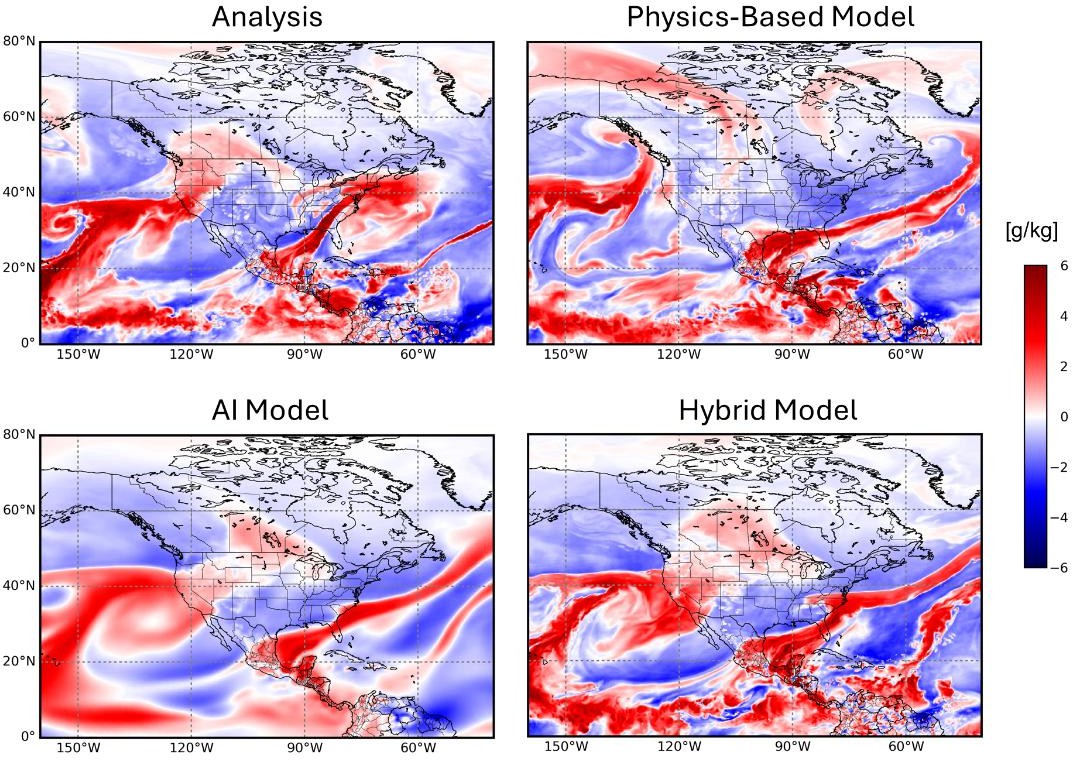
Figure 1. Atmospheric moisture forecasts from three different weather models over North America at 7:00 pm EDT on 1 February 2025 (forecast day 10), during a significant atmospheric river event impacting northern California. The colours represent moisture anomalies, indicating unusually dry (blue) or moist (red) air at the 700 hPa level. ECCC’s operational analysis, representing the best estimate of the atmospheric state at the same valid time, is also shown for reference.
3. HYBRID AIWP-NWP MODELLING: THE BEST OF BOTH WORLDS
Based on these insights, a natural question arises: can a hybrid modeling approach combine the strengths of both paradigms? The objective is to achieve the large-scale accuracy of AI-based models while retaining the fine-scale detail represented in physics-based models and generating the full range of predicted variables that operational meteorologists rely on. This motivation led to the development of a new hybrid modeling framework at ECCC, among the first of its kind (Husain et al. 2025).
At its core lies the physics-based GEM model. During simulation, the large-scale weather patterns predicted by GEM, involving spatial scales larger than approximately 2,500 km, are gradually adjusted toward the predictions of the AI-based GEML model. This adjustment mechanism is known as spectral nudging, in which large-scale corrections are obtained by computing the differences between the meteorological fields predicted by GEM and GEML, followed by the application of a spectral filter to isolate the scales of interest.
More specifically, spectral nudging is applied to the solution of GEM’s adiabatic and inviscid dynamical core at every model time step. The nudged solution is then passed to the physical parameterization schemes, which compute the physical tendencies required to obtain the final model state for that time step. As a result, the large-scale components of GEM evolve toward those predicted by GEML, while the smaller-scale structures that are critical for weather extremes, such as heavy precipitation and severe storms, remain free to evolve in accordance with GEM’s established physical and mathematical formulations.
This hybrid modeling approach based on spectral nudging leads to substantial improvements in forecast accuracy, along with a predictability gain of approximately 12–24 hours, depending on the season (Husain et al. 2025). In practical terms, this means that the accuracy of a day-6 forecast from the hybrid model can be comparable to that of a day-5 forecast from the standalone physics-based GEM model. Improvements of this magnitude in operational weather prediction typically require 7–10 years of research and development, whereas the integration of AI enabled these gains to be achieved in less than two years.
Figure 1 illustrates the characteristics of NWP, AIWP, and hybrid weather models using atmospheric moisture forecasts during a significant atmospheric river event affecting northern California. ECCC’s operational analysis is shown in the top-left panel. It represents the best estimate of the atmospheric state. For the different weather models, forecasts valid at day 10 are presented.
The top-right panel in Fig. 1 shows the forecast from the physics-based GEM model. It captures substantial fine-scale detail, including sharp and localized structures such as narrow filaments of dry and moist air. The bottom-left panel shows the forecast from the AI-based GEML model. Compared to GEM, large-scale moisture patterns predicted by GEML are considerably better aligned with the analysis. For example, the atmospheric river over the Pacific Ocean makes landfall over northern California, consistent with the analysis, whereas the physics-based GEM forecast incorrectly tracks the system toward British Columbia. However, the AIWP forecast appears substantially smoother and lacks realistic local-scale structure.
Finally, the bottom-right panel in Fig. 1 presents the forecast from the hybrid AIWP–NWP model. Through large-scale spectral nudging, the broad-scale circulation patterns are constrained toward the AI-based solution, while the smaller-scale structures are generated by GEM’s physics-based dynamics and parameterizations. The resulting forecast therefore combines more accurate large-scale patterns than the standalone GEM model with more realistic fine-scale detail than the AI-based GEML model.
4. CONCLUSIONS
Like in many scientific disciplines, the advent of artificial intelligence is reshaping weather forecasting and challenging the status quo. However, this evolving paradigm does not imply the obsolescence of traditional physics-based NWP models. Current limitations of deterministic AIWP models, including spatial smoothing, weak representation of localized extremes, a limited set of predicted variables, and a limited ability to generalize beyond the training data, indicate that they remain far from replacing physics-based NWP models.
The hybrid AIWP-NWP framework presented here shows that combining both approaches can yield substantial gains in predictability and therefore represents a promising path forward for the foreseeable future. Advancing such hybrid systems will require continued improvements in both AI and physics-based components, as each plays a fundamental role in shaping the final predicted state.
REFERENCES
- Ben-Bouallègue, Z. 2026: “What is a realistic forecast?” Assessing data-driven weather forecasts, a journey from verification to falsification. Preprint available at https://arxiv.org/abs/2602.00622.
- Bi, K., Xie, L., Zhang, H., Chen, X., Gu, X. and Tian, Q. 2023: Accurate medium-range global weather forecasting with 3D neural networks. Nature, 619: 533-538.
- Bonavita, M. 2024: On some limitations of current machine learning weather prediction models. Geophysical Research Letters, 51 (12), https://doi.org/10.1029/2023GL107377.
- Girard, C. and Coauthors 2014: Staggered vertical discretization of the Canadian Environmental Multiscale (GEM) model using a coordinate of the log-hydrostatic-pressure type. Monthly Weather Review, 142: 1183-1196.
- Hersbach, H. and Coauthors 2020: The ERA5 global reanalysis. Quarterly Journal of the Royal Meteorological Society, 146: 1999-2049.
- Husain, S.Z. and Coauthors 2025: Leveraging data-driven weather models for improving numerical weather prediction skill through large-scale spectral nudging. Weather and Forecasting, 40: 1749-1771.
- Lam, R. and Coauthors 2023: Learning skillful medium-range global weather forecasting. Science, 382: 1416-1421.
- Moldovan, G. and Coauthors 2025: An update to ECMWF's machine-learned weather forecast model AIFS. Preprint available at https://arxiv.org/abs/2509.18994.
- Sun, Y. Q., Hassanzadeh, P., Zand, M. and Abbot, D.S. 2025: Can AI weather models predict out-of-distribution gray swan tropical cyclones? PNAS, 21: e2420914122.
- Zhang, Z., Fischer, E., Zscheischler, J. and Engelke, S. 2026: Physics-based models outperform AI weather forecasts of record-breaking extremes. Science Advances, 12: eaec1433.
Comments 0
No comments yet. Be the first to comment!
Sign in to leave a comment.