
Two Knowledge Rivers Becoming One: Water, Memory, and Empathic Engineering

Abstract
On the mesas near Tuba City in the Navajo Nation, clay is not simply soil. It carries memory. For generations, Navajo artisans have gathered clay from the land and transformed it into vessels that hold water, food, stories, and identity. The process does not begin with equations, optimization routines, or design software. It begins with observation. The artisan studies the landscape, remembers ancestral objects, learns from elders, and reflects on the form the object should take. Materials are collected carefully and respectfully. What is not needed is returned. Stories accompany making. Songs accompany reflection. Design is not separated from life; it is woven into it. A vessel therefore becomes more than an object. It becomes relationship.
Western Scientific Knowledge (WSK) system and hence engineering rarely begins this way. Engineering often begins with data. We measure, define targets, optimize systems, and maximize efficiency. This pathway has given humanity extraordinary achievements. In the water innovation space, we recycle water in spacecraft, desalinate seawater, and engineer materials capable of molecular-scale separations. Yet, somewhere along this journey, engineering became increasingly structured and recipe-driven. The WSK system gained rigor, predictability, and analytical power, but in many ways, it also lost something equally important: heuristics, creative freedom, and the designer’s intimate relationship with place.
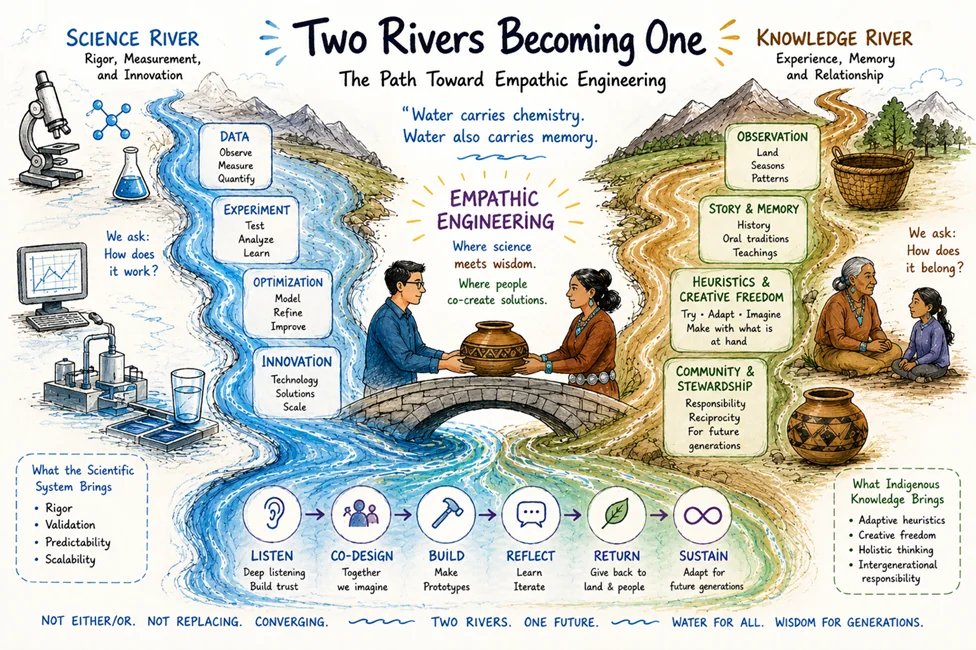
This realization formed the foundation of my recent research, where we argued that future water innovation may depend on reconnecting these two knowledge rivers; i.e., scientific rigor and Indigenous heuristics through empathic engineering.1 The conceptual relationship between these parallel pathways and their convergence through empathic engineering is illustrated in Figure 1. The central premise is not to replace science with Indigenous knowledge (IK), nor to romanticize one system over the other. Rather, it is to recognize that each preserves something that the other lacks. Scientific systems excel at validation, quantification, and reproducibility. Indigenous systems preserve adaptation, observation, creative exploration, and environmental intimacy.1,2
|
Figure 1: Two rivers becoming one: a conceptual illustration of empathic engineering as a convergent pathway between Western Scientific Knowledge (WSK) and Indigenous Knowledge (IK) systems. The scientific river emphasizes rigor, experimentation, optimization, and technological innovation, whereas the knowledge river preserves observation, memory, heuristics, creative freedom, and community stewardship. Their confluence symbolizes an empathic design framework where scientific rigor and Indigenous wisdom co-evolve to produce adaptive, culturally grounded, and sustainable water innovations. |
Indigenous knowledge systems developed under very different conditions from modern science. They evolved not inside laboratories but through centuries of observation and adaptation. Innovation emerged from uncertainty, environmental feedback, necessity, and collective memory. Design unfolded through making, where observation informed intuition, intuition guided experimentation, and experimentation drove adaptation. The process remained open and dynamic. Knowledge was not reduced to fixed rules. Instead, it evolved heuristically. This preservation of creative freedom is perhaps one of the most remarkable characteristics of Indigenous systems and one that modern engineering increasingly needs again.3,4
Such innovation becomes evident when we examine Indigenous innovations around the world. The Waru Waru systems of the Andes buffered crops against frost and drought through raised fields and surrounding canals that regulated moisture and temperature.5 The Zuni people developed waffle gardens that retained water and created agricultural microenvironments under arid conditions.6 Across Pacific islands, traditional catchment systems integrated water harvesting, natural filtration, and groundwater recharge directly into the landscape.1 These were not merely technologies; they were adaptive design systems developed through observation, iteration, and long-term interaction with nature. Their laboratories were rivers and mountains. Their textbooks were stories. Their datasets extended across generations.
One of the most striking lessons from our collaboration with Navajo artisans was discovering how closely Indigenous making resembles engineering while simultaneously extending beyond it. The artisan observes previous designs, mentally envisions possibilities, experiments with materials, reflects, adjusts, and repeats. The process mirrors engineering cycles of ideation, prototyping, testing, and redesign. Yet another dimension exists. The artisan also asks whether the object belongs, whether it respects the land, what should be returned, and whether future generations inherit balance. Engineering often asks whether something can be built. Indigenous systems ask whether it should be built this way. Empathic engineering asks both.1,7
I often think of this relationship as two rivers. The metaphorical convergence of these rivers is illustrated in Figure 1. One river carries equations, mechanistic understanding, experimentation, and scientific rigor. The other carries memory, stories, observation, heuristics, and creative freedom. For centuries these rivers flowed in parallel. The scientific river became increasingly powerful and generated treatment plants, reactors, membranes, predictive models, and sophisticated infrastructure. Yet the same scientific river also narrowed the design space. Optimization often replaced exploration. Rules replaced intuition. Engineering became increasingly efficient but sometimes less imaginative.
The knowledge river followed another path. It preserved flexibility. It preserved adaptation. It preserved relationships with land and community. Most importantly, it preserved designer freedom. This freedom matters because the environmental challenges of the twenty-first century increasingly resemble the conditions under which Indigenous systems evolved: uncertainty, variability, disturbance, and adaptation. Climate change is altering environmental systems in ways that rigid frameworks alone may struggle to address. Thus, adaptive thinking becomes essential once more. Heuristics regain importance, and creative exploration becomes imperative. The future engineer may need to recover what Indigenous systems never lost.3,4
Our work argues that convergence begins not through technology but through listening. Engineers first understand place. They observe landscapes. They learn histories. They speak with communities. Design objectives emerge jointly rather than being imposed externally. Scientific principles remain essential, but they become braided with environmental memory and community understanding. In our work with Navajo collaborators, this philosophy inspired treatment concepts rooted in pottery and basket-making traditions, where local materials, traditional processing methods, and scientific principles entered the same design space. Neither system replaced the other. They converged.1
Perhaps children understand this idea better than adults. Ask a child to draw a river and they rarely draw only water. They draw birds, mountains, fish, trees, clouds, and people. The river belongs to a living world. Engineering education sometimes teaches the opposite by separating systems into isolated variables and components. This reductionism and tendency toward fragmentation gave science extraordinary power, but children remind us that relationships persist.
Climate change is not merely temperature increase. Water scarcity is not merely hydrology. Environmental injustice is not merely infrastructure. These are connected problems, and connected problems require connected thinking. The future engineer may therefore require new skills. The ability to calculate, model, and experiment will remain essential. But equally important may become the ability to listen, observe, imagine, and reflect. The future engineer may become part scientist, part designer, and part storyteller. The future of engineering thus may not lie in choosing between WSK and IK. It may lie in convergence. A water filter can remove contaminants and preserve identity simultaneously. A treatment system can satisfy regulations while honoring culture. Technology can be innovative and ancestral at the same time.
Water has always connected worlds. Rain connects sky with earth. Rivers connect mountains with oceans. Perhaps water can also drive the confluence of the apparently parallel knowledge rivers. And perhaps the greatest engineering innovation of the future will not be another membrane, catalyst, or reactor. Perhaps it will be learning how to design with empathy. Because water carries chemistry. But water also carries memory. Let us remember that human innovation did not begin with modern science; it has been shaped through nearly 70 millennia of observation, adaptation, creativity, and lived experience.
REFERENCES
(1) Sarker, H. S.; Goldtooth, L.; Tso, D.; Numkena, J.; Chong, L. M.; Saleh, N. B. Bridging Indigenous and Scientific Knowledge Systems Is Key to Water Innovation. Nature Water 2026.
(2) Saleh, N. B. Empathic design as a platform for nano-enabled water treatment. Nature Water 2025, 3, 842–843.
(3) Berkes, F. Sacred Ecology; Routledge: New York, 2012.
(4) Cajete, G. Native Science: Natural Laws of Interdependence; Clear Light Publishers: Santa Fe, NM, 2000.
(5) Erickson, C. L. The Lake Titicaca Basin: A Pre-Columbian Built Landscape. In Imperfect Balance: Landscape Transformations in the Pre-Columbian Americas; Columbia University Press: New York, 2000; pp 311–356.
(6) Muenchrath, D. A.; Sandor, J. A.; Norton, J. B.; Homburg, J. A. A Maize Experiment in Traditional Zuni Agroecosystem. J. Ethnobiol. 2017, 37, 172–195.
(7) Hess, J. L.; Strobel, J. Indigenous Ways of Doing: Synthesizing the Literature on Ethno-Engineering. Int. J. Eng. Soc. Justice Peace 2013, 2, 55–80.
(8) Glegg, G. L. The Design of Design; Cambridge University Press: Cambridge, U.K., 1969.
Comments 0
No comments yet. Be the first to comment!
Sign in to leave a comment.