
Executive Summary
Introduction
In 1973, the Taiwan government began investing heavily in semiconductor research because it knew that traditional manufacturing alone would not secure the country's future. A few years later, in 1980, Taiwan established Hsinchu Science Park, bringing together universities, researchers, and technology companies. This marked the beginning of Taiwan's journey toward becoming one of the world's leading technology hubs. At that time, Taiwan was known mainly for manufacturing consumer electronics. But its leaders asked an important question:
"What can a small island produce that the whole world will always need?"
Their answer was semiconductor chips.
Semiconductor chips are the tiny "brains" inside almost every electronic device. They power smartphones, computers, data centers, modern cars, medical equipment, and artificial intelligence (AI). Without these chips, today's digital world simply could not function. To achieve this goal, Taiwan invested in education, engineering, and advanced manufacturing. Universities trained thousands of engineers, while the government encouraged companies to develop cutting-edge semiconductor technology.
In 1987, a new company changed everything: Taiwan Semiconductor Manufacturing Company. Unlike most semiconductor companies, TSMC decided not to design its own chips. Instead, it focused entirely on manufacturing chips for other companies. This business model, known as a semiconductor foundry, was revolutionary.
Over the following decades, global technology companies—including Apple, NVIDIA, AMD, and Qualcomm—trusted TSMC to manufacture their most advanced chip designs. As manufacturing technology improved, TSMC successfully produced increasingly smaller transistors, moving from micrometer-scale manufacturing to today's advanced 3-nanometer process technology. Smaller transistors make chips faster, more energy-efficient, and more powerful.
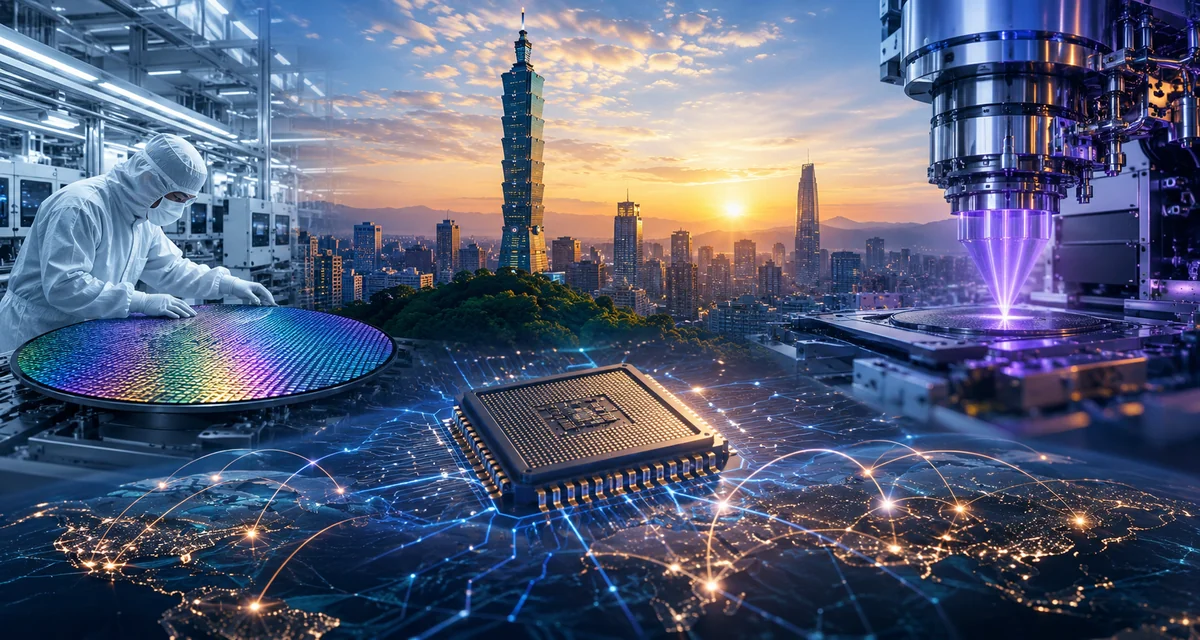
However, TSMC's success depends on another remarkable company located over 9,000 kilometers away in the Netherlands: ASML.ASML builds the world's only commercially available Extreme Ultraviolet (EUV) lithography machines. These machines use extremely short-wavelength ultraviolet light to print microscopic patterns onto silicon wafers. Without EUV technology, producing today's most advanced chips would be almost impossible.
Building one EUV machine is extraordinarily difficult. Each system contains over 100,000 individual components supplied by hundreds of highly specialized companies across Europe, the United States, and Asia. Some companies manufacture ultra-precise mirrors, others develop powerful laser systems, while many produce sophisticated sensors, optics, software, and electronic components.ASML brings all of these technologies together into a single machine. If even one critical component does not meet its required precision, the entire system cannot operate correctly.
This is why no other company has successfully developed a commercial EUV lithography system comparable to ASML's.Because these machines are extremely complex, they are produced in limited numbers each year. Customers often place orders years in advance, and delivery typically takes a long time due to strong global demand.
Among ASML's largest customers, TSMC has maintained one of the closest and longest partnerships. By planning its investments early and purchasing large numbers of machines, TSMC is usually among the first companies to receive ASML's newest equipment. This creates a powerful advantage.
ASML provides TSMC with the world's most advanced manufacturing tools, while TSMC uses decades of manufacturing experience to produce the world's leading chips. Even if another company buys the same EUV machine, achieving the same results is not easy. Making advanced chips requires years of experience. Engineers must carefully control thousands of manufacturing steps, reduce microscopic defects, improve yield—the percentage of working chips produced from each silicon wafer—and keep production costs low.
Today, Taiwan's semiconductor industry is supported by an entire ecosystem that has developed over more than four decades. Universities educate skilled engineers, suppliers manufacture specialized materials, research institutes continue developing new technologies, and companies work closely together to improve production. This has made Taiwan one of the most important links in the global semiconductor supply chain.
If chip production in Taiwan were seriously disrupted, the effects would be felt around the world. Smartphone launches could be delayed, AI development could slow, automobile production could be interrupted, and many industries that rely on advanced electronics would face shortages. For this reason, many experts describe Taiwan's semiconductor industry as a "Silicon Shield." The idea is simple: because so many countries depend on Taiwan's semiconductor manufacturing, Taiwan has become strategically important to the global economy.
Every day, thousands of engineers in Hsinchu and other technology centers work inside ultra-clean factories. They operate ASML's advanced machines, measuring processes in nanometers and producing chips that eventually power millions of devices across the globe.
Most people never think about Taiwan, TSMC, or ASML when using a smartphone or computer. Yet behind almost every major technological breakthrough lies the quiet work of these companies. Taiwan's story is not one of military power or vast natural resources. It is the story of long-term planning, investment in education, world-class engineering, and decades of technological innovation.
Conclusion
That is why Taiwan is widely recognized today as the world's leading advanced semiconductor manufacturing hub and a hidden superpower. Together, TSMC and ASML have helped build the foundation of the modern digital age—one tiny chip at a time.
Youtube Video
Comments 0
No comments yet. Be the first to comment!
Sign in to leave a comment.