Executive Summary
Youtube Video (Open directly)
Introduction
Something unusual is happening in job markets worldwide. Entry-level positions that once absorbed new graduates are vanishing from the job market. Mid-career professionals find their roles unexpectedly restructured or eliminated. Tasks that once required human teams are being completed by... something else. Companies report rising productivity while simultaneously reducing headcount. Workers across industries feel increasingly insecure about their futures, yet struggle to identify exactly what's changing.
A new labor force has arrived — bodiless, tireless, infinitely scalable — and it's completing tasks that previously required human teams.
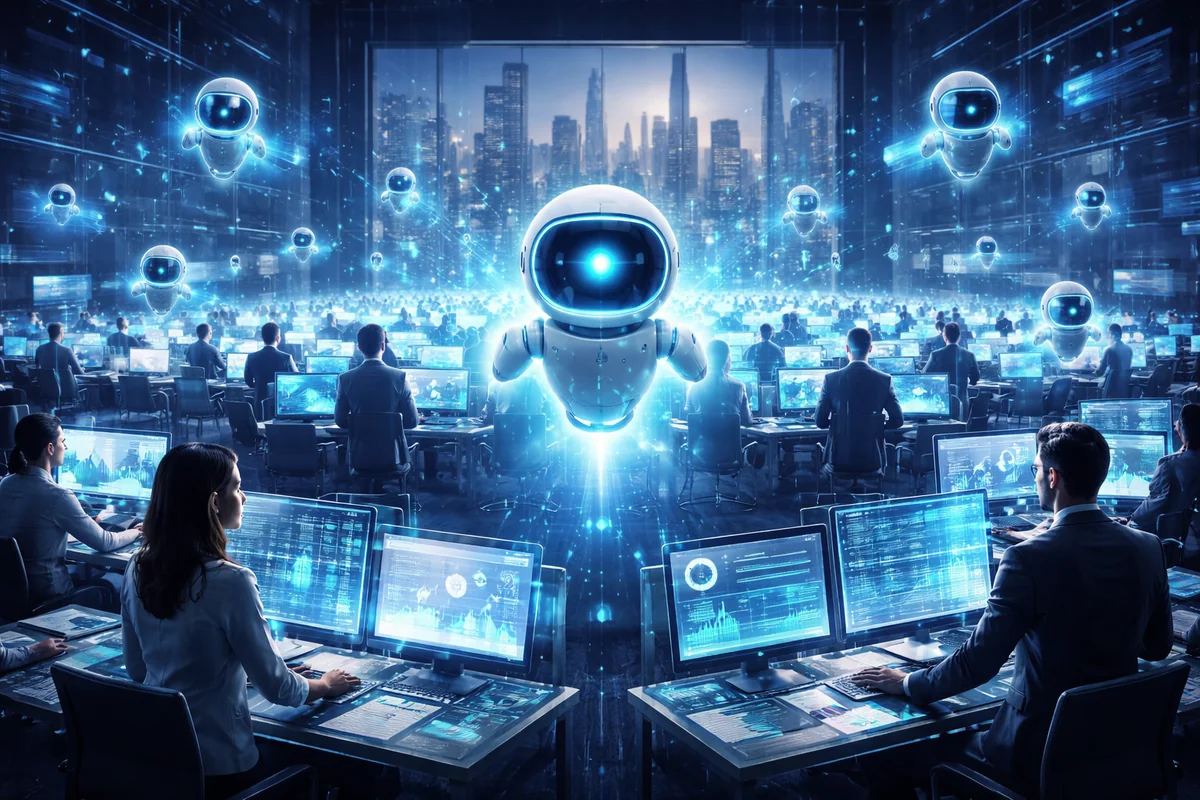
Agentic AI refers to autonomous digital agents — software systems that can understand goals, create plans, take actions across multiple tools and platforms, and continuously improve their output with minimal human supervision. These are not traditional programs waiting for commands. They behave more like digital employees that can be assigned outcomes rather than step-by-step instructions. They operate entirely in the digital space, yet their impact on the real economy is becoming very physical. They are reshaping what it means to work, to build a career, and to participate in the modern economy.
This transformation is happening right now, at scale, across industries. And unlike physical automation that requires hardware and facilities, digital AI agents can be deployed instantly, replicated infinitely, and scaled like cloud computing infrastructure.
From Software Tools to Autonomous Agents
Traditional software has always been reactive. You click a button, it performs an action. You enter data, it processes it. The relationship has been simple: human commands, machine obeys.
Agentic AI fundamentally changes this dynamic. These systems take initiative. Give an AI agent a goal like "Research our top five competitors, analyze their pricing strategies, and prepare a strategic report with recommendations," and it will break that goal into subtasks, search the web and internal databases, run comparative analysis, write reports, revise its output based on quality checks, and even trigger follow-up actions if needed.
This is no longer assistance once its deployed— this is delegation. These agents function like digital employees who don't sleep, don't slow down, and don't stop after completing one task. They can work continuously, learning from each interaction and improving their performance over time.
Beyond Intellectual Work: AI Agents Are Everywhere
Initially, experts predicted AI would mainly affect "thinking jobs" — roles that involved analysis, writing, and decision-making. But agentic systems have proven far more versatile. They are now entering virtually every type of workflow that involves information processing, coordination, or repeatable processes.
Today's AI agents are creating and optimizing marketing campaigns, conducting customer service conversations and resolving support tickets, researching sales prospects and crafting personalized outreach, performing financial analysis and generating forecasts, screening job applications and scheduling interviews, testing software and debugging code, monitoring operations and coordinating logistics across teams.
Anywhere there is a repeatable process, information flow, or decision tree, AI agents can now participate — and often outperform humans in both speed and volume.
Consider a mid-sized e-commerce company: AI agents can now monitor competitor pricing across thousands of products in real-time, automatically adjust pricing strategies based on market conditions, generate and optimize product descriptions for different customer segments, answer customer service inquiries across multiple channels simultaneously, analyze customer behavior patterns and recommend inventory adjustments, and coordinate with logistics systems to optimize shipping routes. Work that previously required separate teams for pricing, content, customer service, analytics, and operations can now be orchestrated by interconnected AI agents. Humans increasingly focus on strategy, exceptions, and relationship management.
We are not just automating individual tasks anymore. We are automating entire job functions, end to end.
The Scalability Shock: Millions of Times Faster
Here's the part society is genuinely unprepared for, the aspect that separates this revolution from previous waves of automation: scalability.
What once took a skilled human professional an entire month to research, process, analyze, and produce can now be executed by AI systems thousands or even millions of times in a single day. That is not an exaggeration — it is the mathematical reality of deploying AI agents in parallel across cloud infrastructure.
Consider this comparison: one human analyst might complete five comprehensive tasks per week. A single AI system can process hundreds of similar tasks simultaneously — handling 50,000 tasks per week, running continuously without breaks, sick days, or vacation time.
This creates an economic force that behaves less like traditional hiring and more like spinning up servers in a data center. In knowledge work sectors and digital operations, labor is becoming software-scalable. This is unprecedented in human economic history.
The Disappearing Rungs of the Career Ladder
For decades, careers followed a predictable structure. Entry-level workers handled research, documentation, coordination, and support tasks. Mid-career professionals managed processes, reporting, and operational oversight. Senior leaders focused on strategy and decision-making. This progression was how people built expertise, developed judgment, and advanced through organizations.
Agentic AI is now automating large portions of the lower and middle layers of this structure. Tasks that once trained juniors and occupied mid-level roles — preparing reports, analyzing data, coordinating workflows, producing documentation, monitoring operations — can now be handled by AI agents at massive scale. As a result, the traditional "career ladder" is losing some of its lower rungs.
It's not just fresh graduates who are affected. Entry-level workers struggle to find roles that build foundational skills. Mid-career professionals in process-heavy positions are seeing parts of their work absorbed by automation. Even middle management layers are thinning as organizations discover they need fewer people to coordinate information flows when AI agents handle routine decision-making and reporting.
But there's a more subtle disruption happening at mid and senior levels: professionals who successfully adopt AI agents become dramatically more productive — so productive that organizations need fewer of them. A senior analyst who once required a team of three can now accomplish the same work alone with AI assistance. A marketing director who previously managed five specialists can orchestrate campaigns with two people and multiple AI agents. The individuals who adapt thrive, but the total headcount shrinks. Success at using AI doesn't guarantee job security when everyone else is becoming equally productive.
The disruption is not about age or experience level — it is about how structured and repeatable a role's core tasks are, and how much AI can amplify individual productivity. Administrative coordinators, junior analysts, process managers, documentation specialists, operational supervisors, and even experienced professionals in data-heavy roles are all feeling the pressure. This creates a fundamental challenge for the workforce: people must move more quickly toward work that involves judgment, creativity, leadership, and system design, because the routine steps that once filled entire careers are disappearing. Yet even mastering AI collaboration offers no guarantee, as enhanced productivity itself drives down the number of positions organizations maintain.
The problem is not a lack of capable people. It's that the definition of valuable human work is being rewritten faster than career paths, training programs, and organizational structures can adapt.
The New Benchmark: Humans vs. Machines
Inside organizations, a subtle but profound shift is happening in how performance is measured and work is designed. For generations, workplace performance was benchmarked human against human — comparing one employee's output, quality, and efficiency against their peers.
Now, increasingly, the comparison is human versus AI. Managers are asking fundamentally different questions: Can an AI agent do this task faster? Can an AI do this cheaper? Can an AI maintain consistent quality? Is human involvement still necessary here, or just traditional?
This changes everything about how work is structured. Tasks are being deliberately broken into smaller, more discrete components, standardized across teams and departments, structured in formats that AI systems can easily process and execute, and documented in ways that make them machine-readable and automatable.
Workflows are no longer designed exclusively around human capabilities, cognitive patterns, and working hours. They are being systematically redesigned for AI compatibility and optimization. Humans are no longer the default worker in many processes. We are becoming the exception, brought in primarily for tasks that machines still struggle with — those requiring deep contextual judgment, ethical decision-making, or genuine creative insight.
Yet this shift, disruptive as it is, also creates new categories of work around designing, managing, and governing these AI systems. The question is not whether humans have a role, but what that role becomes.
What Remains for Human Workers?
This transformation does not mean humans are becoming irrelevant or unnecessary. But it does mean the center of gravity of human work is shifting dramatically upward in the value chain.
Humans will increasingly focus on setting strategic goals and defining organizational direction, making ethical decisions and high-stakes judgment calls in ambiguous situations, building relationships and trust with clients, partners, and stakeholders, providing creative direction and big-picture strategic thinking, and supervising, auditing, and continuously improving AI-driven systems.
The role of the human worker is evolving from operator to orchestrator. Instead of personally executing every step of a process, humans design the system, define the parameters, set the goals, and let fleets of AI agents execute the operational work. Then humans review outputs, make final decisions, and refine the system based on results.
Those who learn how to effectively work with AI — guiding it, correcting it, combining its computational speed with human judgment and creativity — will be exponentially more productive than those who try to compete with it task by task. The future belongs not to those who can think faster than machines, but to those who can think better about how to deploy them.
A Civilizational Turning Point
This represents more than a new chapter in business technology. Agentic AI marks a genuine turning point in human civilization — the moment when we began automating not just physical labor or even individual cognitive tasks, but organized intellectual effort itself. Read more about this in another article titled "The Day Civilization Shifted: How the Release of ChatGPT Changed Everything"
For the first time in recorded history, labor can be copied and deployed like software, intellectual capacity can be scaled like computing power, and across many organizations, entire departments can be partially replaced by coordinated networks of digital agents working in concert.
This raises profound and urgent questions that extend far beyond corporate strategy: How do we prepare students for a world where AI systems perform much of what we once called foundational work? How do we retrain workers at all career stages whose roles are being redefined or eliminated? How do we ensure the massive productivity gains from AI are distributed broadly rather than concentrated among those who own the technology? How do we keep humans meaningfully involved in decisions that affect their lives, communities, and futures?
Current educational systems, social safety nets, labor laws, and economic policies were all designed for a pre-agent world. They assume human labor is the primary input for most economic activity. That assumption is breaking down faster than our institutions can adapt.
Conclusion
We are witnessing the rise of a bodiless workforce — millions upon millions of tireless digital agents performing work that until very recently required human teams, human expertise, and human time. These agents don't take lunch breaks. They don't sleep. They don't negotiate salaries. They simply scale.
This does not mark the end of human contribution to the economy or society. But it absolutely marks the end of work as we have traditionally understood it for the past century. The industrial revolution mechanized our muscles. The information revolution digitized our records and communications. The AI revolution is now automating our organized thinking processes themselves.
The future will belong to those who can design effective systems, direct AI agents strategically, and collaborate with these tools to augment rather than replace human judgment. It will belong to those who understand that the question is no longer whether AI will transform work — it already has. The only question that matters now is how quickly we can adapt our education, our institutions, our policies, and ourselves to a world where intelligence itself has become infinitely scalable.
The age of the bodiless workforce has arrived. The traditional career ladder is being restructured from the bottom up. How we navigate this transition — how we support workers across all levels, how we redesign education and training, how we distribute the gains — will define the next chapter of human civilization.
Foot Notes: Interested in learning more about AI agents and how they could upgrade your work processes? We're helping organizations navigate this transition thoughtfully. Reach out to us at info@belbotika.com.

Comments 0
No comments yet. Be the first to comment!
Sign in to leave a comment.