Executive Summary
Introduction
Artificial intelligence did not arrive as a sudden miracle. It emerged gradually—through decades of curiosity, failure, reinvention, and a handful of decisive breakthroughs that reshaped what machines could do. What began as philosophical questions about machine thinking has evolved into systems that can understand natural language, generate art, write software, and assist in complex decision-making.
This is not merely a technical story. It is a human one. A journey that mirrors how we reason, learn, and ultimately redefine the boundaries of intelligence itself.
The Foundations: Dreams of Thinking Machines (1950–1980)
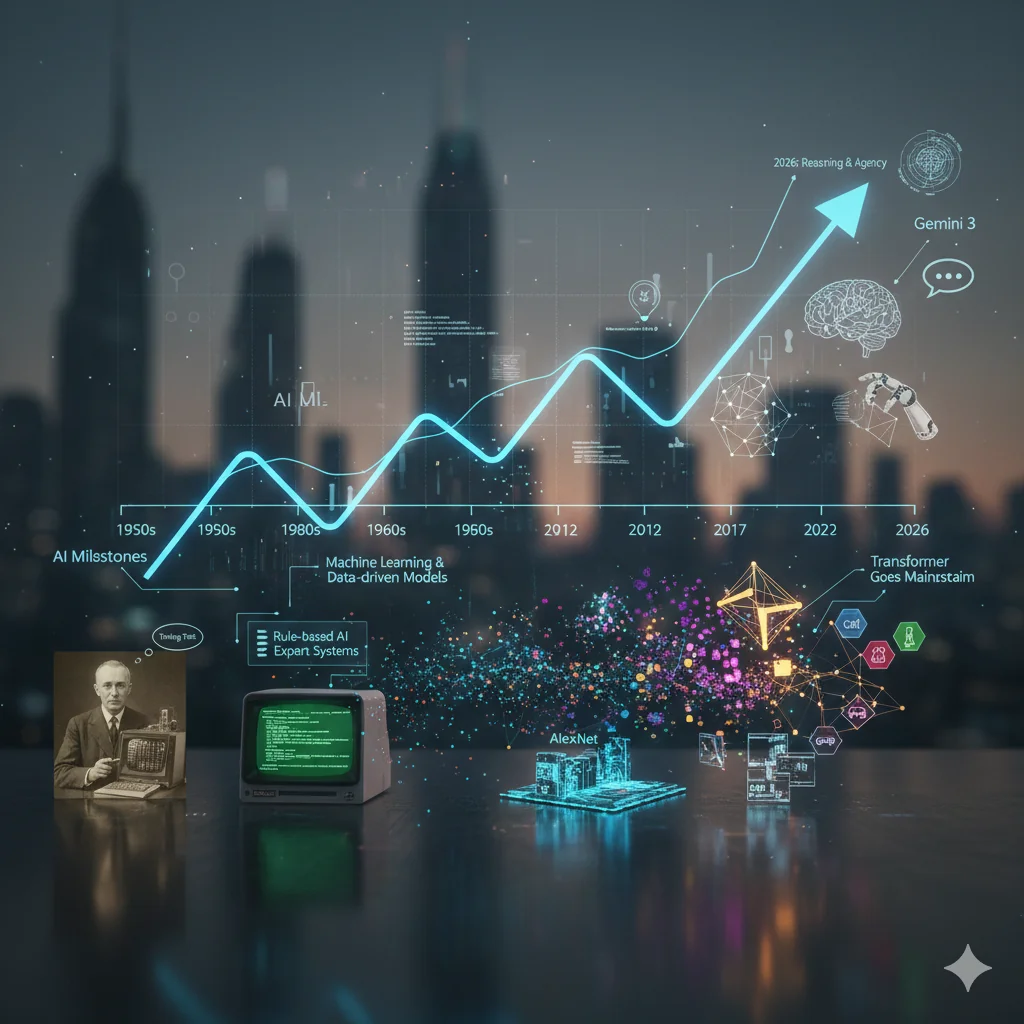
In 1950, mathematician Alan Turing posed a question that still echoes today: “Can machines think?” His landmark paper, Computing Machinery and Intelligence, introduced the Turing Test—suggesting that if a machine could engage in conversation indistinguishable from a human, it might be considered intelligent. This was not just a technical proposal; it was a philosophical provocation that challenged how intelligence should be defined.
The following decades were dominated by symbolic AI and rule-based systems. Researchers believed human intelligence could be encoded explicitly through logic and formal rules. Early programs like ELIZA, which simulated a psychotherapist using simple pattern matching, showed how even limited systems could produce surprisingly human-like interactions.
Yet these systems were brittle. They worked well in narrow domains but collapsed under real-world complexity. Intelligence, it became clear, could not be fully hand-written.
By the 1980s, expert systems brought AI into practical use. Programs such as MYCIN, designed to diagnose bacterial infections, sometimes rivaled human experts. For the first time, AI demonstrated measurable value in medicine, engineering, and finance. Still, these systems were costly to maintain, difficult to scale, and unable to adapt when rules broke or data was incomplete.
The Learning Revolution: When Data Replaced Rules (1990–2010)
The 1990s marked a fundamental shift in philosophy. Instead of programming intelligence directly, researchers embraced machine learning—systems that could learn patterns from data. This change was profound: rather than telling computers what to do, we showed them examples and let them infer the rules themselves.
Algorithms such as decision trees, support vector machines, and ensemble methods became the workhorses of applied AI. Spam filters improved dramatically. Recommendation systems began shaping how people discovered products, media, and information. AI was no longer a laboratory experiment; it was quietly embedding itself into everyday software.
The 2000s accelerated this trend. The internet produced an unprecedented volume of data—search queries, social interactions, images, transactions. Companies like Google demonstrated how large datasets combined with clever algorithms could reshape entire industries. PageRank revolutionized information retrieval, yet the underlying models still struggled with complexity, context, and scale.
Deep Learning Changes the Game (2010–2016)
Around 2010, neural networks returned from near obscurity. With the rise of GPUs and massive datasets, deep learning began outperforming traditional approaches across benchmarks that had stood for decades.
In 2012, AlexNet shattered expectations in image recognition. This was not an incremental improvement—it was a paradigm shift. Tasks once considered uniquely human—vision, speech, and language perception—suddenly became solvable at scale. AI systems moved from manually engineered features to learning representations directly from data.
Machines were no longer just calculating. They were beginning to perceive.
The Transformer Era: Architecture Meets Scale (2017–2020)
A defining breakthrough arrived in 2017 with a paper titled “Attention Is All You Need.” The transformer architecture introduced attention mechanisms that allowed models to process entire inputs simultaneously while focusing on the most relevant parts. This overcame the sequential limitations of earlier neural networks.
Transformers enabled a new generation of language models. BERT transformed natural language understanding by learning bidirectional context. GPT-2 demonstrated coherent, open-ended text generation across diverse topics. These systems hinted at broader capabilities—but the true inflection point arrived in 2020.
With GPT-3, the era of foundation models began. A single model, trained once on vast amounts of data, could perform dozens of tasks through simple prompting—translation, summarization, explanation, and code generation. This marked a shift from narrow intelligence to general-purpose capability.
At the same time, multimodal systems like DALL·E blurred the line between language and vision. AI could now generate images from text and reason across multiple forms of information. Previously isolated AI systems were converging into unified models.
The Mainstream Moment: AI Becomes Personal (2022–Present)
November 2022 marked a cultural inflection point. When ChatGPT was released, it reached one million users in just five days—the fastest adoption of any consumer technology in history. Its significance lay not only in capability but in accessibility. For the first time, advanced AI was available to anyone through simple conversation.
Momentum accelerated rapidly. GPT-4 demonstrated advanced reasoning, multimodal understanding, and professional-level performance across exams and real-world tasks. Competition intensified as Google, Anthropic, Meta, and others launched rival systems. An AI arms race was underway.
By late 2023, AI had moved beyond text. Systems could see, hear, speak, browse the web, execute code, and interact with software in real time. AI shifted from a tool users operated to a collaborator they worked alongside.
Across industries, the impact multiplied. Healthcare embraced AI-assisted diagnostics and drug discovery. Education adopted personalized tutors. Creators found new partners in writing, design, and music. AI was no longer merely automating tasks—it was amplifying human capability.
The AGI Question: How Close Are We?
As AI systems grow more capable, a central question inevitably arises: Are we approaching Artificial General Intelligence (AGI)? Broadly defined, AGI refers to a system that can understand, learn, and apply knowledge across any domain at a human level, without being narrowly specialized.
By this definition, today’s AI systems are not AGI. They do not possess self-directed goals, persistent memory, intrinsic motivation, or grounded understanding of the physical world. Their intelligence is powerful but shallow—broad in scope, limited in agency.
Yet recent progress has blurred boundaries once thought firm. Modern foundation models already display general capabilities: transferring knowledge across domains, learning new tasks from minimal instruction, reasoning through unfamiliar problems, and coordinating tools. Abilities once considered prerequisites for AGI are now emerging incrementally.
Many researchers now view AGI not as a single breakthrough moment, but as a continuum. Each generation narrows the gap by improving reasoning, planning, multimodal understanding, and autonomy. The question may not be when AGI arrives, but how gradually it emerges—integrated into tools and systems long before it earns a definitive label.
Whether AGI is decades away or closer than expected, one truth is clear: the path toward it is no longer theoretical. The building blocks are visible, and the direction is unmistakable.
Standing at the Threshold
Whether or not we call it AGI, intelligence is becoming more general, more accessible, and more deeply embedded in human systems. In just over seventy years, AI has progressed from abstract theory to a daily companion. Each era solved a fundamental constraint—rules gave way to data, data to deep learning, deep learning to scalable architectures, and architectures to general-purpose models.
This is not an endpoint. It is an acceleration point.
The most important questions ahead are no longer purely technical. They are human: How do we collaborate with intelligent systems? How do we preserve agency, creativity, and meaning? And how do we ensure this power benefits many, not few?
What began as a dream of thinking machines has evolved into collaborative intelligence—systems designed to extend human capability rather than replace it. In trying to build intelligence, we have been forced to better understand our own.
The next chapters are being written now—in research labs, startups, classrooms, and living rooms around the world. Artificial intelligence has moved from science fiction into everyday reality, and its influence will only deepen.
We are not just observing this transformation.
We are participating in it.

Comments 0
No comments yet. Be the first to comment!
Sign in to leave a comment.