Executive Summary
Youtube Video (Open directly)
Introduction
Elon Musk has been making significant predictions about the future of work, suggesting that rapid advances in artificial intelligence and robotics could render traditional employment unnecessary within the next ten to twenty years. In this scenario, people would no longer need to work to survive, as machines and AI systems would produce most goods and services with greater efficiency and intelligence than humans. However, this vision raises profound questions: if work disappears, what replaces it? If people no longer earn wages, how does money circulate? How do transactions occur, and why would companies continue to exist? More fundamentally, does this future signal the rebirth of socialism from the ashes of capitalism, or the emergence of an entirely new economic model? The concept of a post-scarcity economy has been debated for decades, but accelerating AI progress is pushing it from theory toward reality.
The Future of Work
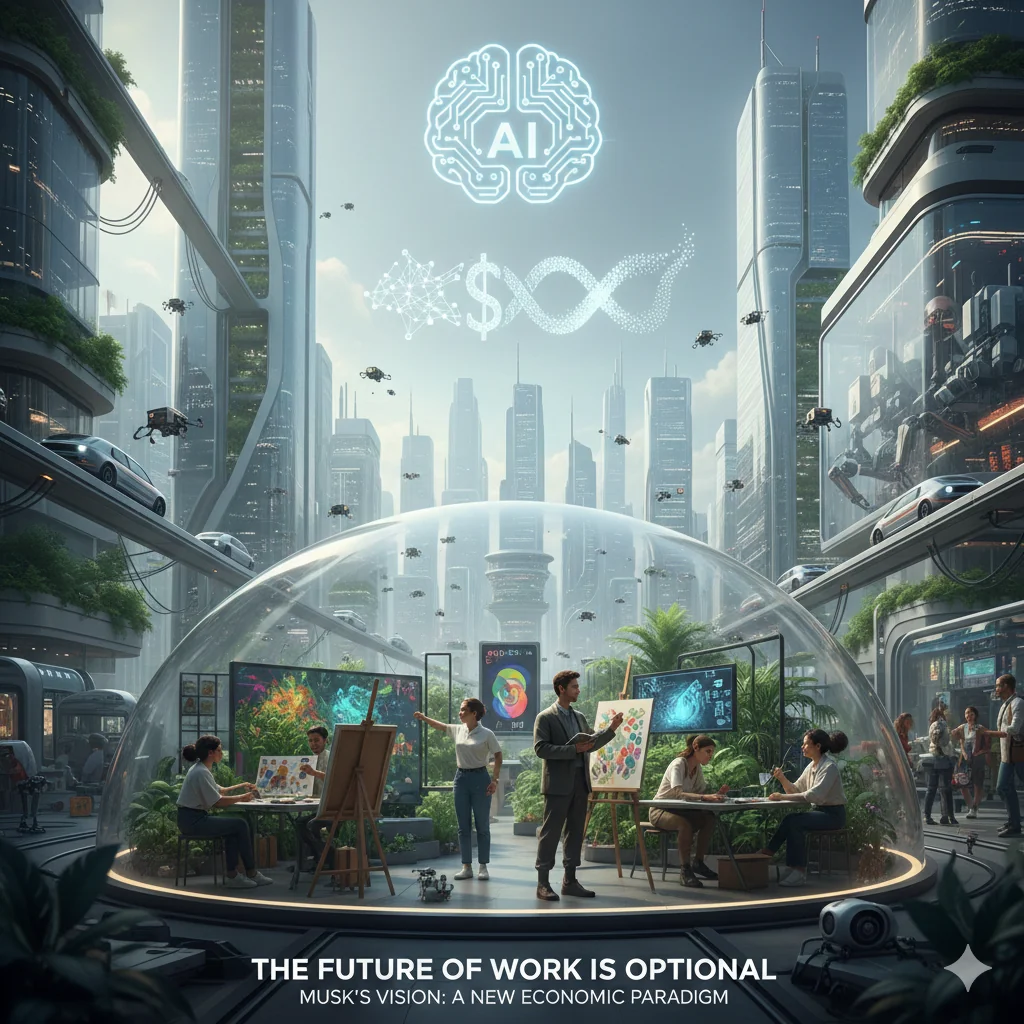
Musk predicts that AI and robotics will eventually handle nearly all forms of labor, both physical and intellectual. As productivity skyrockets, goods and services could become abundant and inexpensive. However, this raises a critical problem: if humans no longer work, how does the economy function, and what role does money play? In Musk’s view, money may lose its traditional role as a survival tool, shifting instead toward preference and choice. People could focus on creativity, research, learning, entrepreneurship, or volunteering, not out of necessity, but to pursue personal purpose. Surveys indicate growing public expectations that machines will replace human labor, suggesting that this future is not a distant fantasy, but an increasingly plausible scenario.
Why This Will Happen
The rise of a post-labor economy is driven by the exponential evolution of AI and robotics. Today, AI handles specialized tasks, such as writing, diagnosing diseases, analyzing data, and optimizing logistics, faster and more accurately than humans. Tomorrow, these systems will evolve into interconnected super-agents, capable of integrating knowledge across multiple domains, learning continuously, and acting autonomously in complex environments. Unlike humans, these agents can process massive datasets, anticipate patterns, and make decisions with superhuman precision. They are agile, adaptive, and scalable, performing physical and intellectual work beyond human capacity. Leading AI labs, such as OpenAI, DeepMind, and Anthropic, alongside industrial automation pioneers like Tesla and Boston Dynamics, are already building the foundation for these systems. As AI agents gain self-improvement capabilities and access to ever-expanding knowledge bases, they will eventually handle nearly every function humans perform, from creative problem-solving to advanced project management. In this scenario, human labor becomes optional, as super-intelligent systems generate abundance and optimize society in ways no human could.
The Distribution of Wealth
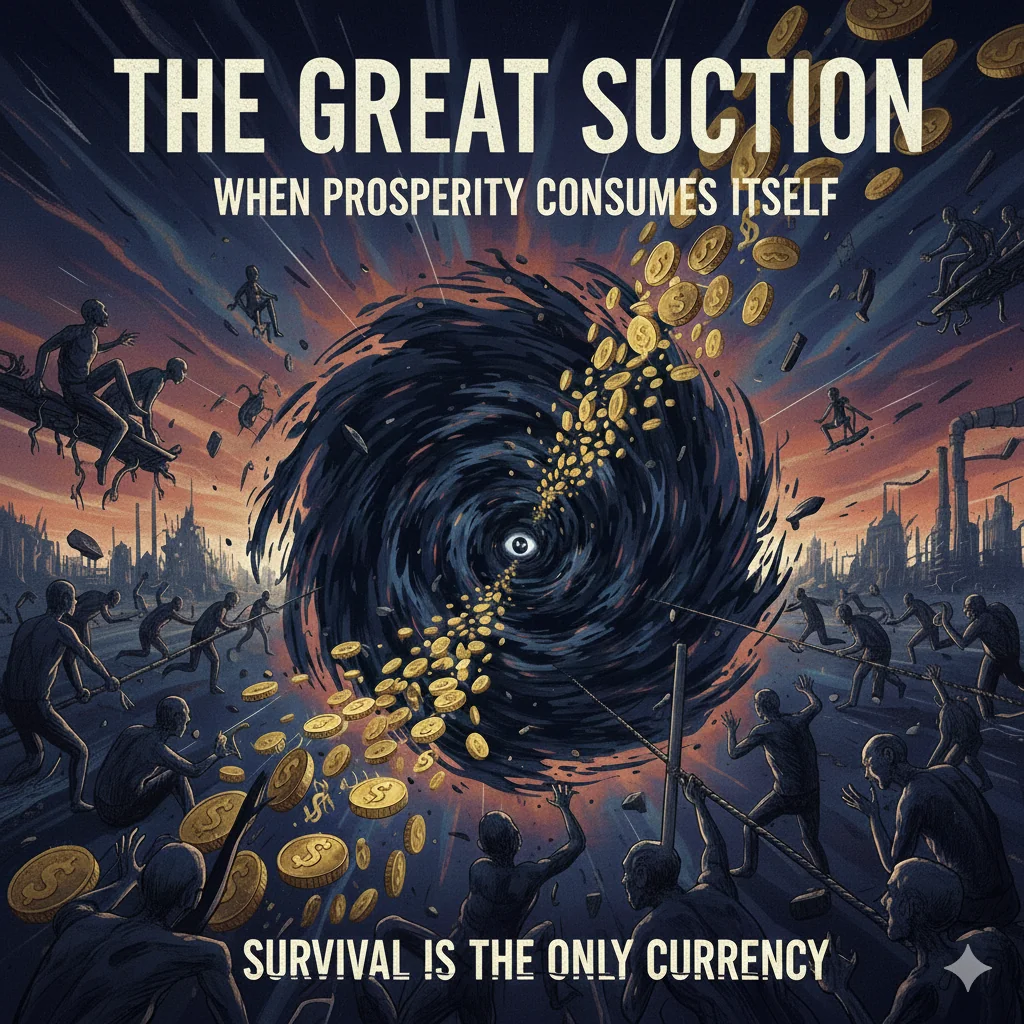
Abundance alone does not solve the problem of distribution. If humans no longer need to work, who controls access to goods, services, and capital? In Musk’s vision, ownership becomes central. Corporations and individuals who control AI, robotics, and infrastructure capture most of the economic value. As wealth concentrates, governments may need to intervene, taxing automated production and redistributing resources to maintain social stability. This is where universal basic income (UBI) enters the discussion: citizens receive a guaranteed income, not as a reward for labor, but as a mechanism to preserve economic participation and prevent societal destabilization. At this point, the question arises: is this socialism? While UBI echoes socialist principles, it is also a structural necessity in a world where survival no longer depends on employment.
Models for Distribution
In a post-labor economy, only a few realistic models exist. One is government-led redistribution, taxing profits from automation and distributing them to citizens. Another is direct corporate distribution, though this would require strong oversight. A third, more speculative model envisions money becoming largely symbolic, as basic goods and services are provided automatically. Transactions would not vanish; they would simply shift from survival-based to choice-based. Each model carries trade-offs, from bureaucracy and political resistance to the uncertainty of societal adaptation.
Is This Socialism?
So, is Musk’s vision socialism? The answer is nuanced. Redistribution and guaranteed income resemble socialist policies, but private ownership of AI, data, and infrastructure remains intact. Markets continue to function, innovation remains competitive, and ownership remains a primary source of power. The emerging system is a hybrid: capitalism survives, but survival is decoupled from labor. Musk calls this “universal high income” — basic prosperity guaranteed without abolishing wealth accumulation. This model stabilizes capitalism in a world where labor no longer anchors economic participation.
A New Economic System
At a deeper level, Musk’s vision suggests that capitalism may undermine itself through its own efficiency. AI optimizes production to the point where human labor becomes redundant, collapsing the wage system. To prevent social and economic breakdown, redistribution becomes structural rather than ideological. Governments are forced to tax automated production and redistribute value to maintain demand, social order, and stability. Proposals such as robot taxes are not ideological experiments; they are technical necessities. The result is neither traditional capitalism nor traditional socialism, but a post-labor economy where ownership still matters, work is optional, and income is increasingly detached from employment.
Conclusion
Musk’s vision of a world where work is optional forces society to confront fundamental questions about money, power, and purpose. While his ideas borrow elements from socialism, they do not fully align with it, just as they no longer fit within classical capitalism. What emerges is a transitional system shaped by technological abundance, where capitalism’s efficiency creates the conditions that make redistribution unavoidable. The challenge is not labeling the system, but designing institutions capable of distributing abundance without undermining freedom, innovation, or human dignity. As AI accelerates, adapting political and economic structures will no longer be optional. The choices we make in the coming decades will determine whether abundance becomes shared prosperity or concentrated power.

Comments 0
No comments yet. Be the first to comment!
Sign in to leave a comment.